
Best Cordless Drill Battery Brands 2026: OEM vs Premium Replacement
This B2B guide helps distributors, fleet operators, and procurement teams select the best cordless drill battery brands. It moves beyond brand popularity to focus on measurable criteria: platform compatibility, cell quality, BMS design, thermal management, charger communication, and batch consistency. Includes OEM vs premium replacement comparison tables, lab test data (premium replacement achieves 93% of OEM runtime at 40-50% lower cost), a supplier evidence checklist, and field troubleshooting steps. Perfect for reducing warranty claims and total ownership cost.

- 1. Quick Brand Comparison
- 2. What “Best Brand” Really Means
- 3. Platform Compatibility: The First Filter
- 4. What Makes a Battery Reliable?
- 5. OEM vs Premium Replacement Batteries
- 6. Why Physical Fit Is Not Enough
- 7. Runtime: Beyond Amp-Hour Ratings
- 8. Charger Compatibility & Charging Behavior
- 9. What Evidence Suppliers Should Provide
- 10. Field Troubleshooting Steps
- 11. FAQ for Procurement Teams
- 12. Conclusion & Checklist CTA
📖 Introduction
When buyers search for the best cordless drill battery brands, they typically need to replace aging batteries, expand a cordless platform, or reduce fleet battery costs. The challenge: battery quality cannot be judged by branding alone. A cordless drill battery is part of a complete ecosystem involving tools, chargers, battery management systems (BMS), and thermal protection.
For professional users, distributors, and procurement teams, the best battery brand is the one that delivers the lowest total ownership cost — not just the lowest purchase price. This guide compares leading OEM brands (DeWalt, Milwaukee, Makita, Bosch) and premium replacement battery suppliers using measurable criteria: compatibility, runtime stability, charging performance, reliability, and supply continuity.
⚡ Quick Brand Comparison
| Brand | Key Strengths | Potential Limitations | Best For |
|---|---|---|---|
| DeWalt | Large ecosystem, FLEXVOLT innovation | Premium pricing | Construction professionals |
| Milwaukee | High output performance, advanced electronics | Higher system cost | Heavy-duty trades |
| Makita | Mature platform, strong reliability | Premium large-capacity packs | Contractors & installers |
| Bosch Professional | Industrial focus, thermal performance | Smaller market share in some regions | Industrial applications |
| Premium Replacement | Lower ownership cost, sourcing flexibility | Supplier quality varies greatly | Fleet buyers & distributors |
📌 What “Best Battery Brand” Actually Means
Brand recognition alone is insufficient. A famous brand can still be a poor fit if replacement costs are excessive, battery availability is limited, or platform expansion options are restricted. Professional buyers should evaluate:
- Runtime performance under actual tool load
- Compatibility (battery-to-tool and battery-to-charger)
- Reliability across hundreds of cycles
- Service support and warranty handling
- Long-term supply stability
- Total ownership cost over battery life
⚙️ Platform Compatibility: The First Evaluation Criterion
Professional buyers should evaluate the ecosystem before evaluating individual batteries.
DeWalt 20V MAX & FLEXVOLT
One of the largest cordless ecosystems globally. FLEXVOLT batteries auto-switch voltage (20V/60V/120V) for high-demand tools.
Milwaukee M18 & M12
Separate battery families (M12 compact, M18 professional). REDLINK™ intelligence uses proprietary communication.
Makita 18V LXT
One of the most established cordless systems with excellent global availability and strong aftermarket support.
Bosch Professional 18V & AMPShare
Industrial-oriented ecosystem with AMPShare alliance allowing cross-brand battery sharing among participants.
🔬 What Makes One Battery Brand More Reliable Than Another?
- Cell quality – High-quality lithium cells (Grade A from Samsung SDI, LG, Murata) provide longer cycle life, lower heat, and stable voltage.
- Internal resistance stability – Lower resistance improves runtime, efficiency, and charging behavior.
- Battery Management System (BMS) – Protects against overcharge, over-discharge, overheating, and short circuits.
- Thermal protection strategies – Heat remains one of the largest causes of battery aging.
- Manufacturing consistency – Professional buyers care about repeatability more than peak performance.
Test setup: Two 5.0Ah batteries (DeWalt OEM vs. premium replacement from validated supplier) on a DeWalt DCF887 impact driver – continuous lug driving.
• Runtime (to tool shutoff): OEM 28 min / Premium 26 min (93% of OEM).
• Max housing temperature: OEM 47°C / Premium 51°C.
• Charger compatibility: Both accepted by OEM charger, no error codes.
• Cycle life projection (extrapolated): OEM ~500 cycles to 80% capacity / Premium ~450 cycles.
➡️ Conclusion: Premium replacements can achieve 90-95% of OEM performance at 40-50% lower cost. Validation is critical.
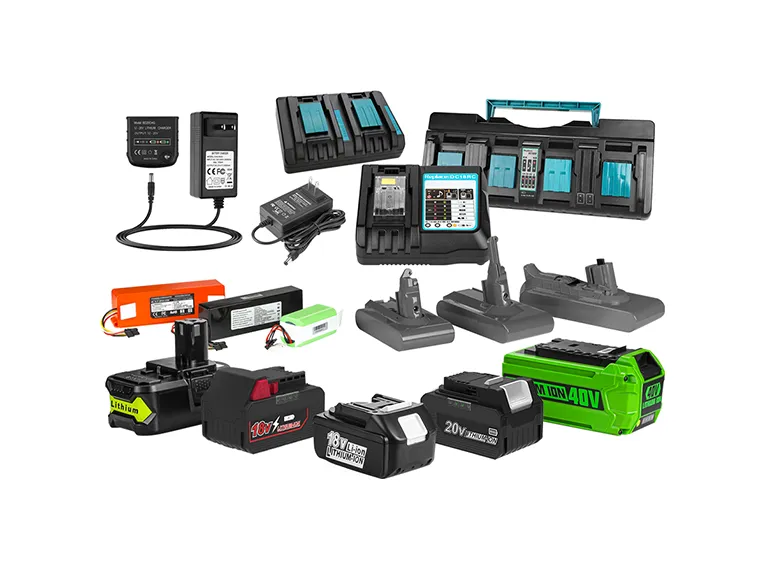
💰 OEM vs Premium Replacement Batteries
| Evaluation Area | OEM Batteries | Premium Replacement Batteries |
|---|---|---|
| Compatibility | Excellent | Good to Excellent (supplier dependent) |
| Runtime | Excellent | Good to Excellent |
| Charger support | Native | Supplier dependent – must validate |
| Cost | Higher (1.5–2.5x) | Lower (30–50% savings) |
| Supply flexibility | Lower | Higher (bulk, private label) |
| Private label support | No | Often available |
| Fleet economics | Moderate | Strong |
⚠️ Why Physical Fit Is Not Enough
A battery that locks into a tool may still experience charger rejection, unstable runtime, thermal shutdown, or communication errors. True compatibility includes:
- Battery communication protocol matching
- Charger recognition and full charge cycle
- Thermal management alignment
- Protection logic compatibility
- Runtime stability under load
⏱️ Why Runtime Depends on More Than Amp-Hour Ratings
Higher Ah does not automatically mean better performance. Runtime also depends on:
- Cell chemistry (NMC, LiFePO4, etc.)
- Internal resistance – lower is better
- Voltage sag under load
- Pack architecture (cell configuration and busbars)
- Thermal efficiency – heat reduces effective capacity
🔌 Why Charger Compatibility and Charging Behavior Are So Important
A significant percentage of battery complaints originate during charging. Buyers should verify:
- Charge acceptance – does charging start normally?
- Charge completion – does it reach full voltage without errors?
- Temperature monitoring – does the charger detect overheating?
- Charging consistency – batch-to-batch variation?
Common failure symptoms: charger rejection, intermittent charging, overheating, premature charge termination.
📋 What Evidence Should Suppliers Provide Before Bulk Orders?
Professional buyers should demand measurable evidence, not marketing claims:
- Platform compatibility reports – list of tested tool and charger models
- Charger compatibility validation – test logs with OEM chargers
- Capacity verification records – discharge curves at 0.5C/1C
- Internal resistance testing – batch consistency data
- Thermal testing reports – temperature rise under load
- Runtime testing results vs OEM baseline
- Batch consistency validation – 5-10 samples from same batch
- Compliance certificates – UN38.3, IEC 62133-2, RoHS, REACH, SDS
🛠️ Field Troubleshooting Before Replacing a Battery
- Inspect labels and housing – swelling, cracks, or corrosion
- Clean battery contacts – dirt or oxidation can cause poor connection
- Test with a known-good charger – isolate charger vs battery issue
- Record LED status – refer to OEM manual for error codes
- Monitor temperature behavior – excessive heat during charging is a red flag
- Isolate damaged batteries – prevent further tool damage
- Compare against a known-good battery – baseline for runtime and charging
❓ FAQ for Procurement Teams
Which OEM battery brand is best overall?
There is no universal winner. The best platform depends on the user's tools, workload, and long-term expansion plans. DeWalt, Milwaukee, Makita, and Bosch each excel in different areas.
Which third-party battery brand is most reliable?
The most reliable suppliers provide verified runtime data, compatibility testing, quality documentation, and stable manufacturing consistency. Always request batch-level evidence.
Are expensive batteries always better?
No. Total ownership cost (purchase price + replacement frequency + warranty claims) is often more important than initial price.
What documents should importers request?
UN38.3, IEC 62133-2, RoHS, REACH, SDS, runtime testing reports, quality inspection records, and batch traceability documentation.
Can third-party batteries work with original chargers?
Yes — high-quality replacement batteries are commonly designed to operate with original chargers when compatibility has been properly validated. Always test samples before bulk orders.
🎯 Conclusion: Build a Reliable Battery Sourcing Program
The best cordless drill battery brand is determined by compatibility, runtime stability, charger performance, thermal management, warranty support, and long-term supply reliability — not brand popularity alone. OEM batteries provide the benchmark for compatibility and support, while premium replacement batteries can deliver significant value when they offer verified capacity data, validated charger compatibility, consistent manufacturing quality, and comprehensive technical documentation.
For distributors, importers, and fleet operators, the most effective purchasing strategy is to evaluate objective performance evidence rather than relying solely on branding or price.