
BMS & Firmware Behaviors in Milwaukee-Compatible Replacement Packs
Practical, non-marketing guide explaining how BMS logic, thermistor/ID signaling, and firmware handshakes determine Milwaukee compatibility, why mismatches create field failures, and which field, bench and procurement checks must be completed before deployment.
1. Safety First
If a pack is swollen, smoking, sparking, above ≈50 °C or producing odors, stop immediately, isolate outdoors on a non-combustible surface, tag the serial/lot, and route it to a certified lab. Do not open packs or bypass protections. Field checks should be limited to OCV measurement, swap tests and IR spot scans. Bench work requires current-limited supplies, PPE and blast-rated containment for destructive procedures.
2. BMS Basics — What the Pack Controls and Reports
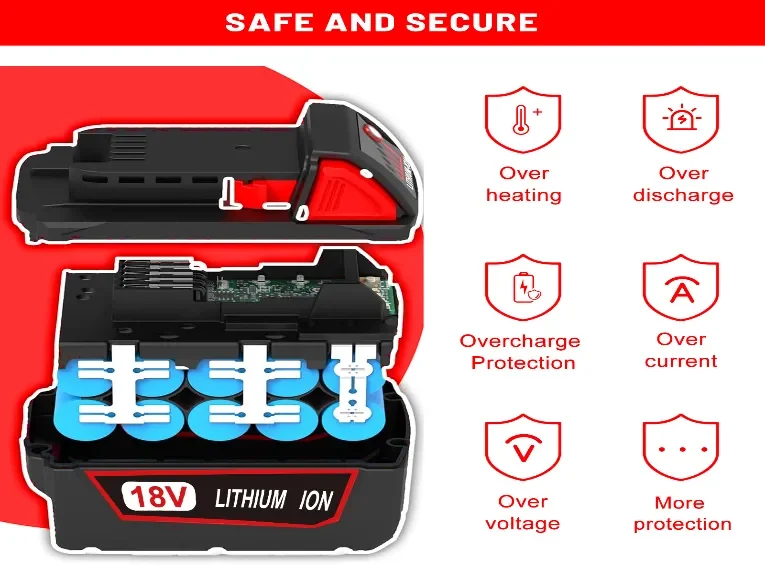
Key BMS behaviors influencing Milwaukee compatibility include voltage limits, balancing, overcurrent and short-circuit protection, thermal sensing, pack-ID signaling, event logs, and SOC reporting. These behaviors determine whether a tool or charger permits operation, derates current, or shuts down.
3. Firmware & Handshake Behavior in Milwaukee Systems
Milwaukee tools evaluate thermistor resistance, ID resistor or EEPROM/one-wire data, sense-pin voltage levels, and in some cases a short serial handshake. Sampling occurs at insertion with strict timing windows. Correct values enable high-power modes and fast charging, while small deviations in pull-ups, ADC scaling or timing often cause derates or rejection.
4. Common Incompatibilities and Observable Symptoms
Thermistor curve mismatches or swapped pinouts may trigger hot/cold faults or charge refusals. Incorrect or missing ID values allow charging but block boost modes or distort fuel-gauge readings. High internal resistance or weak welds cause sag-based shutdowns. Timing deviations create intermittent handshake failures, LED flicker or brief derates. Proprietary authentication can make an otherwise functional pack appear dead.
5. Field Triage
Complete safety checks, then run swap tests with known-good tools and chargers. Record LED behavior, OCV and temperatures, and perform a short sag test. If symptoms are consistent across devices, escalate to bench captures.
6. Bench Captures and Lab Checks
Record insertion-event waveforms, thermistor tables, ID-pin voltages, EEPROM data, BMS event logs, DCIR pulses, slow-make behavior, contact-resistance values, and IR thermal profiles. Use a current-limited supply for reverse/short evaluation and a programmable load for sag characterization. Capture handshake lines at ≥100 kHz. Validate thermistor curves in an environmental chamber. Preserve raw data for supplier negotiations.
7. Telemetry, OTA Updates and Security
Telemetry and OTA firmware add operational visibility but can also change handshake behavior. Require signed firmware, rollback capability and change notifications. Maintain a golden matrix of firmware versions and conduct compatibility retesting whenever an update is issued.
8. Acceptance Test Matrix
Mechanical fit, latch strength, charger acceptance across all OEM chargers, tool handshake validation on golden units, thermistor curves from 0–40 °C, ID resistor or EEPROM verification, DCIR pulse performance, slow-make behavior, insertion-endurance results, and safety documents including UN38.3 and independent propagation reports. Define pass thresholds for charge current, thermistor tolerance, sag limits and boost-mode enable timing.
9. Procurement & Contract Requirements
Supplier must provide six sample packs per lot for golden-matrix testing; full thermistor R-T table and wiring diagram; ID-mechanism details and BMS state-machine description; raw DCIR and handshake logs; signed firmware/OTA policy with rollback; and UN38.3 plus independent pack-level safety reports. Warranty must cover handshake and compatibility defects for twelve months, with lot quarantine if failure rates exceed the agreed threshold.
10. Quick Decision Flow
Record symptoms → perform safety triage → run swap tests → capture handshake/thermistor/DCIR data → reject or request corrective action → run a limited telemetry pilot → approve fleet rollout after pilot success.
11. Troubleshooting Cheatsheet
No LEDs or no response typically indicates missing ID or a dead pack; check OCV and charge acceptance. Hot/cold faults point to thermistor mismatches; measure ambient resistance. Charging without boost usually indicates incorrect ID; check resistor or EEPROM. Load-cutout behavior often reflects high DCIR or BMS trips; run pulse-IR and review logs. Intermittent operation suggests timing issues; capture the insertion waveform.
12. FAQ
Q: Do tool firmware updates improve compatibility?
A: Occasionally, but changes are infrequent. Most issues originate from pack-side behavior, so always pilot test.
Q: Can ID resistors be spoofed?
A: Avoid such modifications because they bypass safety logic and are not acceptable for fleet use.
13. Fleet Implementation Checklist
Maintain a golden matrix of tools and chargers, require sample testing, track pack firmware and serials, enforce compatibility clauses, and run a 30–90-day telemetry pilot before large-scale deployment.