
Charging Algorithm Overview — How Makita Charger Optimize Battery Life
Charging algorithms are the firmware and control logic that turn a power supply into a safe, effective charger. For Makita-style Li-ion tool packs the algorithm must balance three goals: safely restore energy (speed), avoid actions that accelerate aging (longevity), and reliably handle protection/BMS handshakes. This note explains the common algorithm building blocks (precondition/wake, CC–CV, taper/termination, thermal compensation, balancing and adaptive aging logic), how they protect cells, and which tests you can run to verify correct behavior.
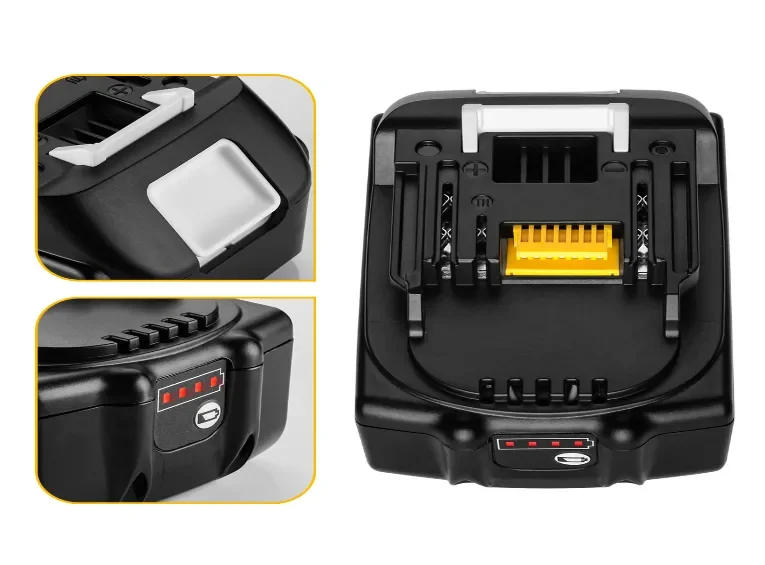
Safety first
-
Never bypass BMS protections or short pack terminals to “force” a charge — doing so risks thermal runaway. Use only isolation, current limiting and proper PPE when bench-testing chargers or packs. Quarantine packs that swell, smell, smoke or overheat.
-
Use the OEM charger or a properly qualified equivalent for Li-ion packs; chargers that ignore pack thermistors, ID pins, or safety handshakes can damage cells even if voltages look correct.
-
For lab work use an isolation transformer, differential probes on scopes, and temperature monitoring (IR or thermocouples) throughout the charge cycle.
What a good charger algorithm actually does
At a system level a charger performs: safe wake/preconditioning for deeply discharged packs, controlled constant-current (CC) bulk charge to bring cells up aggressively but safely, constant-voltage (CV) taper to finish charging without overvoltage, reliable termination to avoid overcharge, temperature-aware derating/lockout, and cooperation with pack BMS and cell-balancing mechanisms. A modern charger also logs events and may adapt the profile over time based on pack impedance or fault history.
Algorithm building blocks — detailed walkthrough
1) Precondition / wake
When a pack’s voltage is very low the BMS often locks outputs. The charger should first run a low current “wake” sequence (e.g., C/20 → C/10 style ramp) to confirm the pack accepts small current and to allow the BMS to re-enable the main path. This protects weak cells from sudden high stress.
2) Constant-Current (CC) bulk stage
After wake, charger supplies a controlled CC (often between C/2 and 1C for tool packs depending on spec) to quickly restore most capacity. CC limits avoid excessive I²R heating and let the charger measure pack voltage response and temperature in real time.
3) Constant-Voltage (CV) taper stage
When pack voltage approaches the pack’s maximum (pack CV = per-cell target × series count) the charger holds voltage and allows current to taper. This removes remaining charge without pushing cells past voltage limits. For Li-ion, correct CV accuracy and stability are critical to avoid overvoltage stress.
4) Termination & top-off logic
Chargers detect end-of-charge by current falling below a termination threshold (I_term) or by timeouts and derivative checks (dI/dt). Good chargers combine: (a) current threshold (I < I_term), (b) maximum CV time limit, and (c) sanity checks (no excessive voltage overshoot). Avoid float charging for Li-ion — trickle is usually only a wake/maintenance microcurrent.
5) Thermal compensation & derating
Charge current and termination thresholds are adjusted by measured temperature (pack thermistor + charger sensors). If pack or charger temps exceed safe windows, the algorithm reduces charge current or refuses charge. Proper thermistor placement and hysteresis prevent late or false trips.
6) Balancing cooperation
Balancing is often a pack-side activity (passive bleed or active balancing). Charger algorithms can support balancing by periodic top-off phases, controlled CV hold times, or by enabling balance currents via handshake signals. Chargers should avoid repeatedly performing short partial charges that prevent balance completion.
7) Handshake, ID & safety gating
Many packs present ID/resistor coding or simple comms. Charger uses handshake to verify pack type, expected CV, and allowed max current. If handshake fails the charger typically stays in wake/trickle or refuses charge.
8) Adaptive and diagnostic algorithms
Advanced chargers adapt over time: they can infer pack internal resistance (from V/I response), detect rising DCIR trends, limit current for aged packs, and store fault/event logs (e.g., repeated thermal derates). These features protect long-lived fleets by trading charge speed for life.

Implementation notes engineers should watch
-
CV precision & ripple: poor CV regulation or high HF ripple accelerates side reactions and heating. Specify low ripple at battery terminals and validate under load.
-
Termination safety: termination on a single metric (timer only) is risky. Combine current threshold with CV time limit and thermal checks.
-
Wake current sizing: too low wastes time; too high risks damaging deeply discharged cells. Use progressively increasing, instrumented wake.
-
Sensor placement & filtering: noisy thermistor readings or slow sensor coupling cause false derates or delayed trips — tune filtering and ensure firm thermal contact.
-
Handshake failure modes: implement conservative defaults (trickle/refuse) and clear LED/error reporting so users don’t repeatedly try unsafe retries.
Reproducible verification tests
Field checks
-
Swap test: charge suspect packs on known-good charger and suspect charger with known-good pack to isolate side.
-
Observe charge curve: with a current clamp or inline meter capture I(t) and V(t) for a full charge. Expect a clear CC plateau, CV hold, and taper to low I. Photograph LED states and timings.
-
Temperature monitor: log pack surface temp at 1, 5, 15 minutes. Unexpected rapid temp rise → issue.
Bench tests
-
Full charge capture: record V(t), I(t), and temperature at ≥1s resolution from cold start to end of CV timeout. Verify CC magnitude, CV target, I_term and CV time are within spec.
-
Wake behavior test: present pack with deeply discharged voltage and monitor wake current and BMS response; confirm controlled ramp and no thermal anomalies.
-
Ripple & transient: differential scope check of terminal ripple under CC and CV; compare to ripple spec (tight spec recommended).
-
Stress cycles: run repeated charge/discharge cycles with IR mapping to detect gradual hotspot development.
Lab/qualification
-
Impedance inference: use charge step tests to measure ΔV/ΔI and infer pack DCIR; verify charger doesn’t push excessive ΔV.
-
Aging comparison: run cohorts charged by different chargers, measure DCIR growth and capacity fade over N cycles to detect charger-induced stress.
-
Fault injection: simulate thermistor open/short, handshake errors and mains transients to verify safe fallback behavior.
Troubleshooting common anomalies
-
Charger never reaches nominal CC — check AC input, internal current-sense (shunt), and handshake preventing full current.
-
Excessive terminal ripple or voltage overshoot at CV — likely aging/high-ESR caps or unstable feedback compensation. Replace caps and retune loop.
-
Frequent early CV timeouts with low delivered Ah — suspect pack imbalance or weak cells; charger is terminating correctly but pack fails to accept finish energy.
-
Repeated thermal derates — confirm sensor placement and thermal coupling; check for poor cooling or charger MOSFET heating.
-
Pack repeatedly needs wake attempts — pack BMS may be latching (deep discharge), or pack has internal leakage/high self discharge; route to lab.
Practical recommendations for fleets & QA
-
Capture and archive one full charge V/I/T trace per pack per charger type for pilot lots — evidence beats assertions.
-
Require chargers to implement CC–CV with documented I_term, CV tolerance, and temperature derate behavior before fleet rollout.
-
Avoid chargers that use timer-only termination or aggressive fast-charge without thermal compensation.
-
Log and review charger fault events; use rising-rate of thermal derates or repeated wakes as a trigger to retire packs or chargers.
Summary — one-line takeaway + 3 immediate actions
Modern Makita-style chargers protect battery life by combining controlled CC–CV charging, temperature-aware derating, safe wake/preconditioning, balancing cooperation and adaptive diagnostics — validate by capturing full V/I/T charge traces and running wake and ripple tests.
Immediate actions:
-
Capture one V(t)/I(t)/T(t) trace from your charger on a representative pack (full cycle) and save it as a golden-unit baseline.
-
Run a wake test on one deeply discharged pack and confirm the charger ramps current safely without thermal excursions.
-
Measure terminal ripple under CC and CV — flag units with excessive ripple for SMPS/capacitor inspection.
FAQ
Q — Do Makita chargers use delta-V or dI/dt termination?
A — For Li-ion tool packs the primary termination is CV with an I_term cutoff and time limit; delta-V is not relied upon as it is more relevant to Ni chemistries. dI/dt checks or derivative current behavior may be used as supplementary indicators.
Q — Why is wake/preconditioning necessary?
A — Deeply discharged packs or BMS-latched packs need a low-current wake to safely re-enable the BMS without stressing weak cells.
Q — Can a charger extend pack life by adaptive algorithms?
A — Yes. Chargers that reduce current for high-impedance/aged packs, limit CV time, and avoid unnecessary rapid partial charges help slow aging compared with chargers that always force maximum current.
Q — Is float charging used for Li-ion packs?
A — No. Continuous float is harmful for Li-ion. Chargers should not hold packs at full CV indefinitely; they use taper termination and only micro-currents for brief wake/maintenance.
Q — How important is thermal sensing accuracy?
A — Critical. Misplaced or slow sensors cause late derates (overheating) or false trips. Verify sensor coupling and algorithm hysteresis during qualification.