
Charging Habits That Kill Ryobi Batteries Faster (And How To Avoid)
Identify the charging habits that accelerate Ryobi ONE+ 18V battery aging, explain the failure mechanisms in plain English, and give prioritized, copy-paste SOPs and measurable thresholds fleets and homeowners can adopt immediately.
What are the safety rules I must follow before any test or charging change?
⚠️ Lead with safety (non-negotiable): Quarantine any pack that is swollen, smoking, leaking or very hot (>50 °C). Never bypass the BMS, never open packs unless you’re a certified repair shop, and always perform tests on a non-combustible surface with PPE and a suitable fire extinguisher at hand. If you encounter odor, visible damage or recurrent thermal events, stop and escalate to a recycling/repair workflow.
What are the core mechanisms by which charging habits kill Li-ion packs?
There are four core mechanisms to understand:
-
Heat (accelerated chemical aging): Elevated temperature speeds SEI growth and side reactions; symptom: rising DCIR, higher sag, faster capacity loss.
-
Lithium plating (cold charging): Charging below ~5 °C risks plating metallic lithium on anodes; symptom: sudden capacity loss and increased internal short risk.
-
Deep discharge & high-SOC storage: Long periods at 100% state-of-charge or routine deep cycles both increase calendar and cycle fade; symptom: higher self-discharge and shorter runtime.
-
Frequent BMS trips / harsh protection cycles: Repeated overcurrent or thermal cutouts create stress cycles that accelerate degradation and can mask cell faults; symptom: intermittent cutouts and inconsistent LED behavior.
Which numeric thresholds should I track right now?
Copy-paste these thresholds into checklists and posters:
-
Storage SOC target: 40–60% (ideal for long-term).
-
Safe charge ambient: ≥ ~5 °C and ≤ ~40 °C.
-
Operational stop / quarantine temp: pack surface > ~50 °C → quarantine.
-
OCV guidance (5-cell, nominal 18 V): Full ≈ 20.0–21.6 V; Usable 18.0–20.0 V; Red flag < ~17–18 V; Severe < ~10–12 V.
-
Voltage sag under light load: Healthy ≤ ~1 V; Suspect > ~2 V.
What are the top charging habits that actually shorten pack life — ranked, and how do I fix them?
-
Leaving packs on the charger overnight (continuous float).
Why: Long time at 100% increases calendar fade.
Fix: Remove pack when charger indicates full; aim for ~80–95% for daily use; do not use charger for long-term storage. -
Regular deep discharge to cutoff.
Why: Deep cycles accelerate irreversible capacity loss.
Fix: Swap at ~20–40% SOC; adopt top-up culture. -
Charging/storing in extreme heat (hot vehicles/garages).
Why: Heat speeds chemical degradation and swelling.
Fix: Charge and store in 10–30 °C shaded areas; quarantine if surface >40 °C and replace if >50 °C. -
Charging cold packs (< ~5 °C).
Why: Risk of lithium plating during charge.
Fix: Warm pack to room temp (15–25 °C) for 30–60 minutes before charging. -
Using cheap/unvalidated chargers or adapters.
Why: No handshake/thermistor support; unstable currents stress cells.
Fix: Use OEM or vendor-validated chargers; require handshake documentation from suppliers. -
Immediate re-charging of hot packs.
Why: Thermal stacking increases internal stress.
Fix: Allow 15–30 minutes cooldown; IR-spot check before charging. -
Continuous 100% top-off for long storage.
Why: High SOC increases calendar aging.
Fix: Store packs at 40–60% SOC for >1 week. -
Single-pack overuse (no rotation).
Why: Uneven wear ages one pack fast.
Fix: Rotate packs daily; log cycles. -
Cramped charger banks with no ventilation.
Why: Heat accumulation during multi-bay charging.
Fix: Space chargers, stagger start times, provide forced air. -
Unmanaged charger firmware updates.
Why: Firmware can change charge curves or handshake policies.
Fix: Pilot firmware updates; require rollback and acceptance tests.
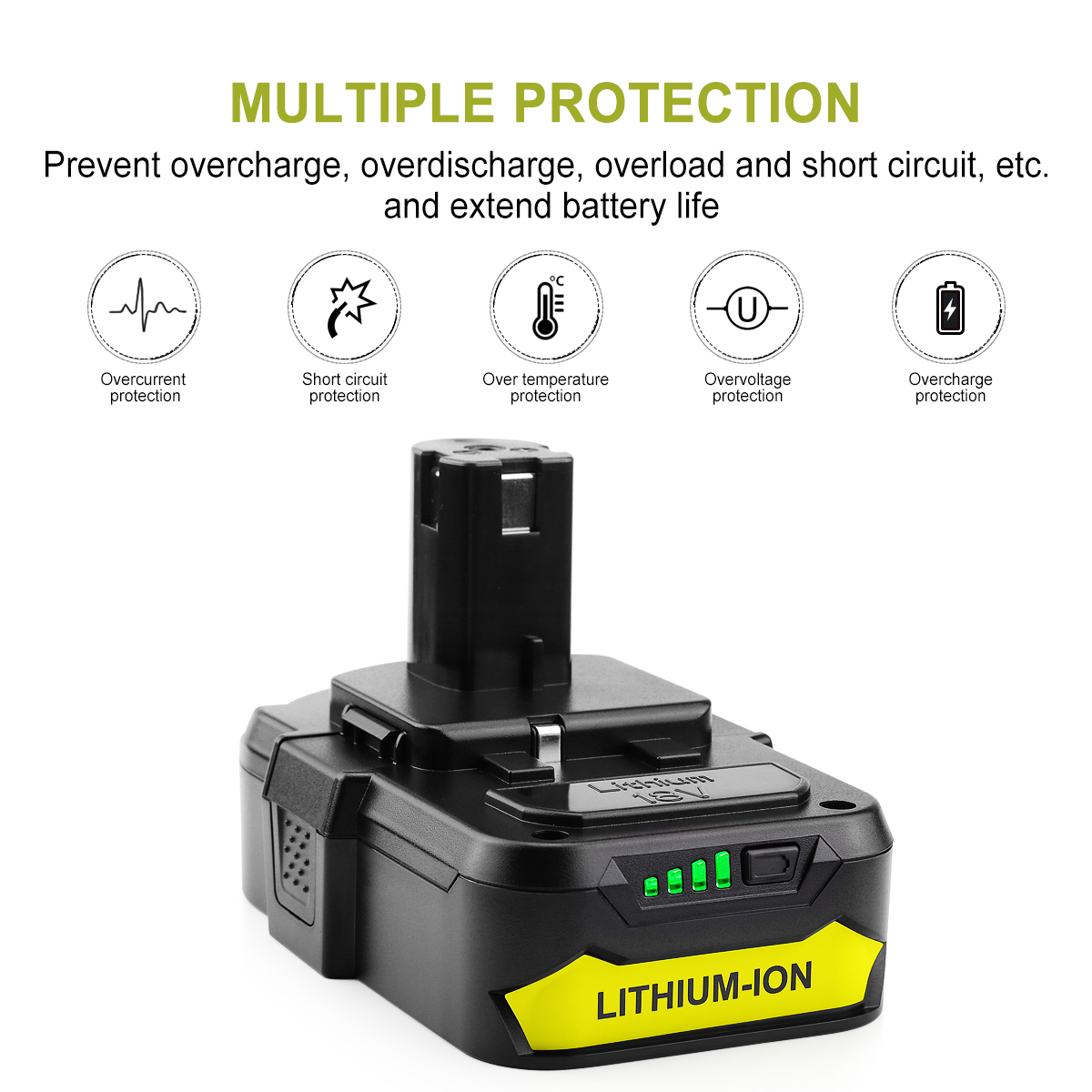
18V Lithium Ion Battery Replacement for Ryobi ONE+ Cordless Tools P108 P192
How should I monitor compliance — what KPIs matter?
-
Daily: IR temperature of top 3 packs post-charge — target <40 °C.
-
Weekly: OCV spot check on 5% random sample — target ≥18 V.
-
Monthly: % of packs stored at 40–60% SOC — target >90%.
-
Monthly: BMS cutouts per 100 cycles — target < 2 per 100 cycles.
Log KPI data weekly and review trends with procurement/ops.
What charger & firmware policies should procurement enforce?
-
Only OEM or validated chargers allowed.
-
Documented thermistor/handshake support required.
-
UN38.3 compliance and preference for UL/IEC lab reports.
-
Pilot sample results (charge acceptance, thermal map) required — test at target ambient and under load.
-
Firmware version tracking, rollback images, and acceptance test plan before fleet rollout.
-
RMA/SLA clauses for thermal or handshake failures.
-
Acceptance test: pilot 5% sample passing runtime and max pack temp under defined load.
What SOPs can I deploy right now — ready to copy/paste?
Operator daily SOP
-
Inspect pack visually for swelling/odors. If present → QUARANTINE and tag.
-
If OK, insert pack into OEM/validated charger; note start time. Remove pack when charger indicates full (green). Do not leave >2 hours after green light unless instructed.
-
If storing >7 days, charge to 40–60% then label with storage date.
-
Rotate pack position each shift; record cycles in your log.
-
Record any charger LEDs or thermal readings >40 °C; escalate to supervisor.
Fleet charging-room SOP
-
Maintain charging room ambient 15–25 °C, ventilated, chargers spaced ≥3–5 cm.
-
Stagger charge start times to avoid simultaneous heat peaks.
-
Use only OEM/validated chargers; log charger firmware version and serial.
-
Weekly sample: pull 5% of packs for OCV + sag test and log results.
-
Quarantine packs with repeated BMS cutouts, sag >2 V, or surface >50 °C; route to RMA.
What quick checklist should techs use in the field?
Field triage (one line): Swollen/smoke/odor/ >50 °C → QUARANTINE. Charger error + good OCV on golden charger → quarantine & tag vendor. Low OCV (<17–18 V) after wake → send to pro. Repeated thermal events → retire.
What common questions will teams ask? (FAQ)
Q: Is daily top-up OK?
A: Yes—light top-ups are fine; avoid maintaining 100% SOC long-term.
Q: Will fast charging harm packs?
A: OEM fast chargers are designed to be safe; repeated high-power cycles raise thermal stress—monitor temps.
Q: How often should I rotate packs?
A: For heavy fleets: daily rotation is recommended; for light users: rotate weekly.
How do I run a pilot and roll these practices out?
30-day pilot plan: pick one crew, implement the Operator daily SOP and Charging-room SOP, start CSV logging (header above), sample 5% packs weekly for OCV & sag, track KPIs weekly. After 30 days evaluate change in: average post-charge temp, % packs in 40–60% storage, and BMS cutouts. If KPIs improve, scale fleet-wide and add procurement clauses for charger validation.
What’s the one-line takeaway I can post on the wall?
Takeaway: Store at 40–60% SOC, never charge <5 °C, don’t charge hot packs (>40 °C), use validated chargers, and rotate packs — small habits save long-term capacity.