
DeWalt Charger: Charge Curves & Model Compatibility
DeWalt’s charger family includes legacy combo units, 20V MAX chargers, high-amp rapid chargers and FLEXVOLT-aware models — each with distinct current profiles and handshake expectations. Mechanical fit alone does not guarantee safe or full charging. Thermistor mapping, BMS ID/EEPROM behavior and charger current limits determine whether a pack charges normally, derates, stalls, or is rejected. Follow the acceptance and QA matrix below to validate compatibility and reduce RMAs.
1 · Safety rules before testing chargers and packs
If a charger or pack smokes, sizzles, overheats (>50°C), or the pack is swollen, move it outdoors to a non-combustible surface, tag QUARANTINE, and treat as hazardous. Never bypass thermistors, BMS protections or attempt live high-current probing without current limiting and certified lab controls.
2 · What a “charge curve” actually represents
A charge curve is current (A) vs time or SOC. It shows initial fast-charge current, tapering behavior, hold stages and any thermal/handshake pauses. Charge curves determine time-to-80%, thermal rise, degradation stress, and whether the charger/pack interaction behaves predictably across temperatures and capacities.
3 · How major DeWalt charger families differ in practice
Legacy combo chargers (e.g., DCB107/DCB101): lower peak current, broad compatibility, slower with large-Ah packs (6Ah+).
20V MAX chargers (e.g., DCB115 family): baseline behavior for 20V MAX ecosystem; implement hot/cold delays and predictable tapering.
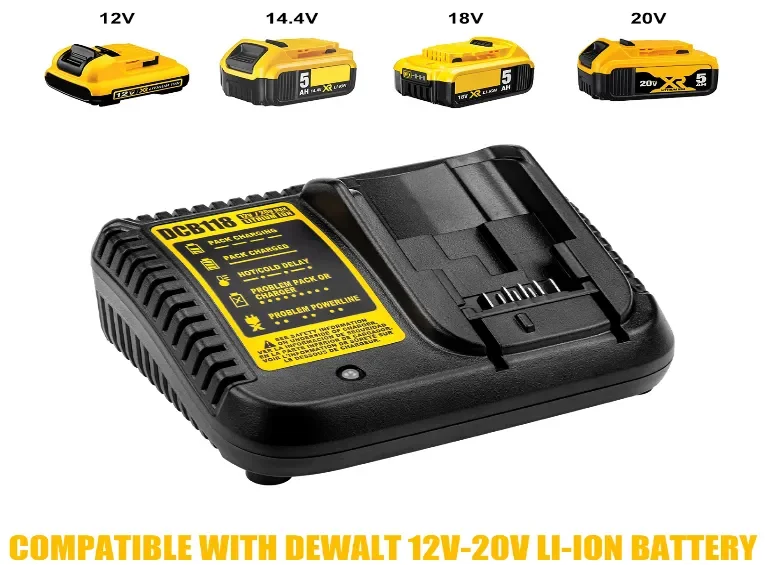
Rapid/high-amp chargers (e.g., DCB118 family): higher peak currents dramatically reduce time-to-80%; pack firmware and thermals govern safe speed.
4 · Why some chargers accept a pack but charge poorly
-
Thermistor mismatch: Charger expects a specific thermistor curve; mismatch causes hot/cold delays or reduced current.
-
BMS ID/handshake mismatches: Charger may read ID or EEPROM fields and reduce current or reject packs.
-
Charger current limits: Older/budget chargers may be under-spec for high-Ah packs, extending charge times.
-
Pack firmware logic: Pack may intentionally derate when it detects unsupported conditions.
5 · Acceptance & QA test matrix
Mechanical & seating: pack latches securely, contact resistance recorded.
Cold/hot delay test: behavior at ~5°C and >40°C.
OCV & start-current snapshot: measure first 30s of charge (A and V).
Time-to-80% / 100%: compare against OEM or supplier claims.
Thermal trace: IR capture every 5 minutes; log case and cell temps.
LED/behavior log: photo/video of charger LED sequence for each test.
Load follow-up: immediately run a representative tool to detect BMS derates.
Repeatability: at least 3 cycles per sample.
Evidence retention: preserve raw logs, IR images, photos and BMS event logs.
6 · Field troubleshooting checklist
Swap test: put suspect pack in known-good charger and known-good pack in suspect charger.
Ambient check: retry at room temp if cold/hot delay suspected.
Start current vs OCV: low start current vs expected suggests thermistor or BMS handshake issue.
Post-charge behavior: if pack shows derates in tool, capture BMS logs and IR trace.
7 · How to size charger banks for fleets
Use measured time-to-full from your real duty profile, not catalog specs. Account for heat accumulation and spacing — dense banks raise ambient so per-charger throughput drops. High-Ah and FLEXVOLT packs typically require more chargers or staggered charging schedules.
8 · Quick FAQs
Q: Will old chargers safely charge new high-Ah packs?
A: Usually yes but slower; verify with your acceptance tests.
Q: Are third-party packs safe to charge?
A: Only when they pass your thermistor/ID and charge-curve tests. Mechanical fit is insufficient.
Q: Does fast charging reduce battery life?
A: It can if pack/charger integration is poor. Validate thermal behavior and long-term aging where possible.
Closing note
Mechanical compatibility is the baseline; true interoperability depends on thermistor curves, BMS handshake, charger current capability, and validated firmware behavior. Use the test matrix and procurement clause above to make compatibility predictable and auditable.