
How to Safely Revive a Deeply Discharged Ryobi ONE+ 18 V Battery
If the pack is swollen, smoking, leaking, hot (>50 °C) or emits a burning smell — stop, isolate outdoors on a non-combustible surface, tag “QUARANTINED”, and arrange professional disposal. Never open the pack or attempt improvised “jump” fixes.
Quick TL;DR
Measure the pack OCV, run the low-risk ordered wake steps (OEM charger wake → alternate charger → light tool wake → warm if cold), monitor temperature, then run a controlled load/sag test. If OCV stays below ~17–18 V or pack shows heat, odor, swelling, or >2 V sag, do not continue — send to a qualified service or recycle.
1 — What “deeply discharged” looks like
Measure Open-Circuit Voltage (OCV) with a DC multimeter before attempting any recovery.
| OCV (V) | Meaning | Action |
|---|---|---|
| 20.0–21.6 | Full / near-full | Normal operation / charge as usual |
| 18.0–20.0 | OK / usable | Charge and test under load |
| ~17.0–18.0 | Red flag / likely BMS trip | Attempt safe wake steps; monitor closely |
| 10.0–12.0 | Severe deep discharge | High risk — do not force-charge; escalate |
| <10.0 | Very severe / probable internal failure | Quarantine & recycle/repair only by pros |
These are practical field bands for a nominal 5-cell (≈18 V) pack — not manufacturer specs. Use them as decision thresholds only.
2 — Tools & safety prep
Minimum kit
-
Digital multimeter (DC, 20–30 V range)
-
OEM Ryobi charger(s) (genuine recommended)
-
A verified “golden” known-good battery and charger for swaps
-
Isopropyl alcohol + lint-free wipes + soft brush (for external contact cleaning)
-
IR thermometer (optional, recommended)
-
Safety PPE: insulated gloves, eye protection
-
Non-combustible workbench area and a Class ABC/BC fire extinguisher nearby
Workspace rules
-
Work on a non-conductive, non-combustible surface.
-
Keep bystanders away.
-
Log serial number, OCV, ambient temp, and time-stamps for every attempt.
3 — 60-second rapid triage
-
Visual check: swelling, cracks, discoloration, leaking? → QUARANTINE.
-
Insert in OEM charger: watch LED patterns for the first 1–5 minutes (temp-wait/charge/err).
-
Verify power: confirm outlet & charger work by charging a known-good battery.
-
Swap test: put suspect pack in another known-good charger; put known-good pack in suspect charger. Record outcomes.
This isolates charger vs battery quickly and safely.
4 — Clean contacts & reseat
-
Power off and remove pack.
-
Use isopropyl and a lint-free wipe to clean metal rails/contacts; brush debris from the slot.
-
Dry and firmly reseat. Poor contact often mimics dead packs.
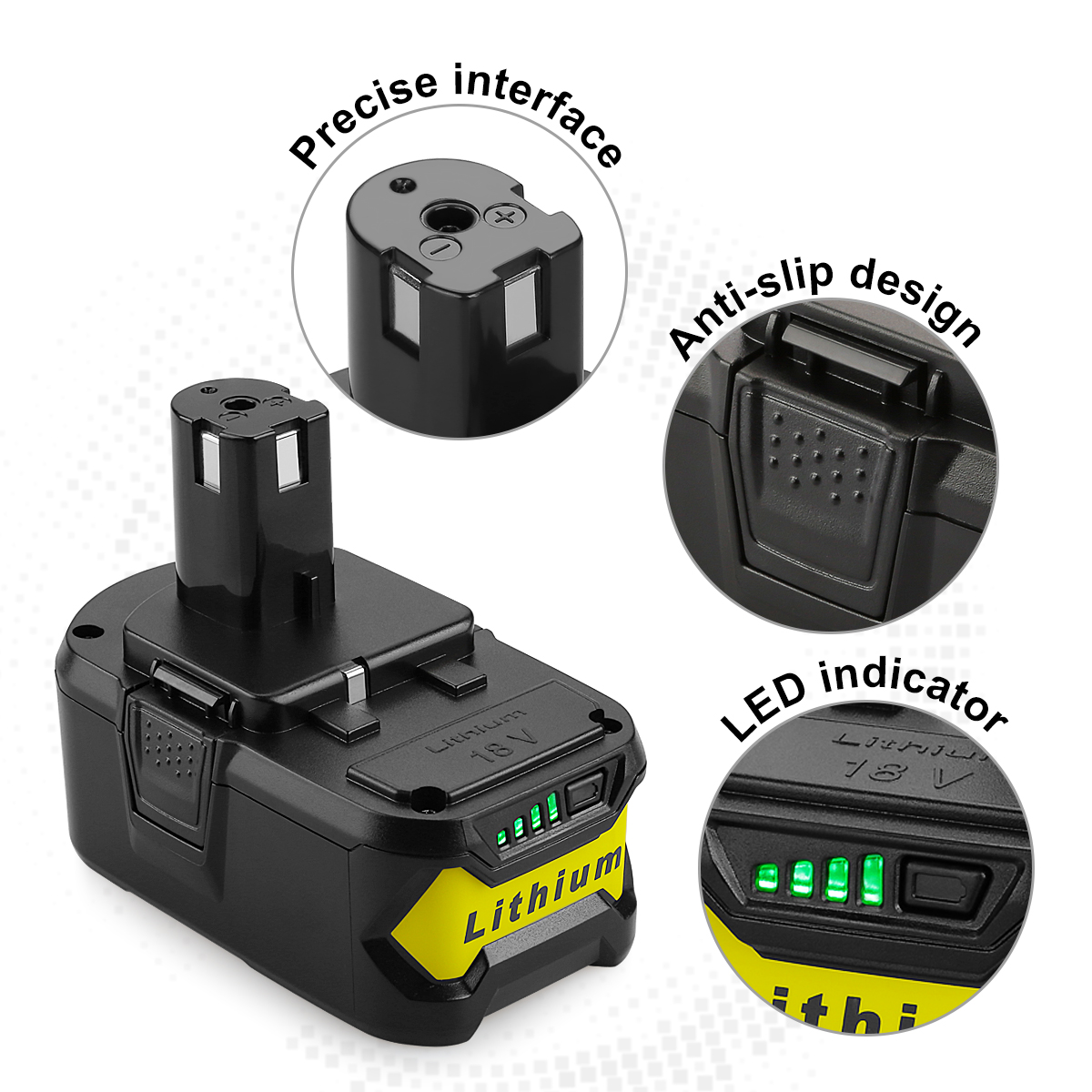
18V Lithium Ion Battery Replacement for Ryobi ONE+ Cordless Tools P108 P192
5 — Measure OCV properly
-
Set meter to DC volts (20–30 V range).
-
Touch red to positive, black to negative terminals; wait 3–5 seconds for stabilization.
-
Record OCV, ambient temp, and pack SN. Use OCV table above to decide next steps.
6 — Safe BMS “wake” sequence
Important: follow in order. Stop immediately if pack heats, smells, emits smoke, or swells.
-
Charger-wake (10–30 minutes)
-
Insert into a genuine Ryobi charger and leave for 10–30 minutes. Many chargers apply a small trickle or monitoring charge to wake a protective BMS. Monitor pack surface temp (IR or by touch with glove).
-
-
Try another OEM charger or another charger slot
-
If you have access to a different genuine Ryobi charger model or slot, try it — firmware/hardware differences sometimes succeed where one charger doesn’t.
-
-
Tool-wake (short, light pulses 10–20 s)
-
Insert pack into a non-high-load tool (e.g., driver set to low) and give short light trigger pulses to wake BMS. Don’t apply heavy loads. Monitor temp.
-
-
Warm the pack (if cold)
-
If pack is below ≈5 °C, bring it to room temp or warm vehicle compartment for 30–60 minutes, then retry charger-wake. Do not use direct heat sources (hair dryer, oven, open flame).
-
If any step produces rapid heating (>50 °C), strong odor, smoke, or swelling, immediately unplug/stop and quarantine the pack.
7 — When to stop and escalate
-
OCV remains < ~17–18 V after safe attempts.
-
Pack surface temp rises rapidly or exceeds ~50 °C.
-
Any burning smell, smoke, or visible deformation.
-
In these cases: do not attempt force-charging. Photograph, log OCV and attempted steps, tag “QUARANTINED”, and send to a qualified recycler or certified repair center.
8 — Advanced revival (technician-only, do NOT DIY)
Qualified technicians may use a bench DC power supply with strict current-limiting to slowly precharge a cell group at very low current (typical initial <100–200 mA) while continuously monitoring temperature and cell voltages. This is a lab-only technique requiring thermal cameras, isolation transformers, fire suppression, and trained staff. It is NOT safe for untrained users.
9 — Verifying usable capacity after a successful wake
If the pack wakes and charges normally:
-
Fully charge using OEM charger.
-
Run a short load/sag test: operate a representative tool or apply an electronic load for 10–20 seconds and record voltage drop.
-
Healthy: ≤ ~1 V sag under typical light/medium load.
-
Borderline: ~1–2 V sag — monitor and consider retiring for critical work.
-
Failing: > ~2 V sag or immediate tool cutout — retire/replace.
-
-
Cycle monitoring: run several charge/discharge cycles and log delivered runtime & max surface temp. If capacity or DCIR degrades quickly, plan replacement.
10 — Repair vs Replace vs Recycle
-
Replace immediately if: swelling, persistent OCV < ~17–18 V after safe wake steps, >2 V sag, hotspots, or odors.
-
Consider professional repair only if diagnostics point to an isolated, fixable BMS or single-cell issue and repair cost < ~50% of new pack price — performed by accredited service centers.
-
Recycle any pack declared unsafe or non-recoverable — use certified recyclers, follow local hazardous-waste rules.
11 — Prevent deep discharge: fleet & storage best practices
-
Store at ~30–50% SOC for long-term storage.
-
Rotate spares frequently and log usage.
-
Check stored pack voltages every 3–6 months and recharge to mid SOC if needed.
-
Avoid leaving packs fully discharged for months and keep packs out of extreme cold/freezing.
-
Use manufacturer-recommended chargers and avoid cheap unverified chargers.
12 — Absolute DO NOTs
-
Do not open or puncture packs.
-
Do not connect packs directly to other batteries (no “jumping” or parallel linking).
-
Do not force-charge with improvised supplies unless you are a qualified lab technician.
-
Do not ignore heat, smells, or swelling — always quarantine.
13 — Short FAQ
Q: Can I “jump” a dead Ryobi battery with another battery?
A: Never. Directly connecting packs is dangerous and can cause fire.
Q: How long should I try waking a pack?
A: Follow the ordered low-risk steps; if no safe improvement and OCV sits in the red zone, stop and escalate.
Q: Will a revived pack be as good as new?
A: Usually not. Deep discharge often causes irreversible capacity loss. Treat revived packs as degraded and use them in non-critical roles if retained.
Q: Is it economical to repair packs myself?
A: No — repairs require professional equipment and expertise; for fleets, compare repair cost vs new pack price and safety impact.
14 — Final notes & responsible practice
Reviving deeply discharged Li-ion tool packs is a last-resort operation. Safety comes first: never bypass protection circuitry, never improvise, and log everything. For fleets, standardize the wake/triage process, keep spare validated packs, and favor replacement over risky repair when in doubt. People and property safety is always worth the replacement cost.