
Kobalt 24V Battery Maintenance: 7 Tips to Extend Life 2026
This B2B guide provides 7 proven maintenance tips to extend Kobalt 24V battery runtime and lifespan. Covers deep discharge prevention, temperature management, proper cooling, storage best practices, contact cleaning, charger compatibility, and health monitoring. Includes aging factors, early warning signs, when to replace, and supplier selection criteria. Essential for fleet operators and repair centers.

Why Do Kobalt 24V Batteries Lose Runtime Over Time?
Kobalt 24V MAX batteries use a 5-cell lithium-ion series configuration (nominal 21.6V, max 29.4V). Capacity degradation is an inherent electrochemical process, but certain behaviors dramatically accelerate it:
- High operating temperatures (>45°C / 113°F) accelerate electrolyte decomposition.
- Repeated deep discharges below the BMS cut-off threshold cause irreversible copper dissolution.
- Long-term full-charge storage (29.4V) increases internal cell stress.
- Extended zero-charge storage leads to passive film growth on the anode.
The Battery Management System (BMS) triggers a protection lock when any single cell drops below 3.0V (15.0V pack). However, discharging to 12.0V (2.4V/cell) or lower causes permanent chemical damage that cannot be reversed by any charger.
Tip #1 — Avoid Deep Discharge (Set Your Own “Gas Light”)
Why it matters: The Kobalt BMS cuts power at ~15.0V to prevent cell reversal. However, repeatedly hitting this hard cutoff gradually increases internal resistance.
Action: Recharge your battery when the tool shows noticeable power drop (around 16.5V – 17.0V), rather than running it until sudden shutdown. If you accidentally drain it to the point where the charger refuses to recognize it (red/green flashing), try the “wake-up” method: insert the battery and leave it on the charger for up to 60 seconds. If it doesn’t recover, the BMS may have permanently locked the pack.
Tip #2 — Maintain Proper Charging Temperature
Why it matters: Charging below 4°C (39°F) causes lithium plating (metallic dendrites), which reduces capacity and poses a short-circuit risk. Charging above 40°C (104°F) accelerates cathode oxidation.
Action: Kobalt’s official safe charging range is 4°C to 40°C (39°F – 104°F). If you bring a battery indoors from freezing weather, allow it to acclimate for at least 1 hour before charging. The charger’s LED will flash slowly (1 flash/second) if the temperature is out of range.
Tip #3 — Allow Batteries to Cool Before Charging
Why it matters: High-draw tools (circular saws, grinders) can heat the internal cells to over 55°C (131°F). Plugging a hot battery into a charger immediately doubles the thermal stress, rapidly degrading the cathode material.
Action: After heavy use, let the battery rest in a shaded, ventilated area for 15–30 minutes until it feels cool to the touch (below 35°C / 95°F) before initiating a charge cycle.
Tip #4 — Store Batteries at the “Goldilocks” Voltage
Why it matters: Storing at 100% SOC (29.4V) accelerates electrolyte oxidation, while storing at 0% SOC causes passivation. The optimum storage voltage for a Kobalt 24V pack is 19.0V – 20.0V, which corresponds to approximately 60% state of charge (roughly 3.8V – 4.0V per cell).
Action: If you won't use the battery for more than 30 days, run the tool briefly to drain it down to 2 out of 4 fuel gauge bars, or measure with a multimeter to confirm 19.5V ± 0.5V. Store in a dry environment (humidity < 65%) with ambient temperatures between 10°C and 25°C (50°F – 77°F).
Tip #5 — Keep Terminal Contacts Clean
Why it matters: Oxidation or debris on the slide terminals increases contact resistance, causing voltage drops that fool the BMS into thinking the battery is depleted, leading to premature charging interruptions.
Action: Inspect the silver-plated terminals every 3 months. If you see dark spots or a dull film, gently rub them with a pencil eraser or a soft cloth lightly moistened with isopropyl alcohol. Pro tip: Many users have replaced perfectly good batteries simply because dirty terminals mimicked a dead cell.
Tip #6 — Use Platform-Compatible Chargers
Why it matters: Kobalt 24V chargers use a specific communication protocol between the BMS and the charger to adjust balancing current and termination voltage. Non-OEM or universal chargers may skip the balancing phase, leading to cell drift.
Action: Always use Kobalt 24V MAX series chargers (models like KRC 24V-1 or KC-2410). If your original charger is damaged, verify that the replacement explicitly states “Kobalt 24V MAX compatible” and supports the proprietary balancing algorithm.
Tip #7 — Monitor Early Health Signals
Why it matters: Degradation is gradual. Catching it early lets you adjust habits before permanent failure.
Action: Watch for these three red flags:
- Runtime drops by >30% under identical load conditions.
- Charging time shortens significantly (e.g., from 60 min to 30 min) — indicating drastically reduced capacity.
- Battery becomes unusually hot during the first 10 minutes of charging.
If any of these occur, perform a controlled discharge test and compare it to the rated amp-hour (Ah) capacity. A loss of 40% or more indicates the pack is nearing its end-of-life.
Every XNJTG replacement battery/charger is tested for correct fit, charger handshake, and thermal cut-off before leaving our facility. We help you avoid the “physical fit but system fail” trap.
Get free technical consultation, sample test reports, and bulk pricing → Contact our engineering team
Diagnostic Reference: Kobalt 24V Charger LED Codes
Use this quick-reference table to decode what your Kobalt charger is telling you:
| LED Status | Fault Type | Solution |
|---|---|---|
| Red flash (1x / second) | Temperature out of range (below 4°C or above 40°C) | Move to room temperature (20-25°C). Wait 1-2 hours and retry. |
| Red rapid flash (3x / second) | Deep discharge lockout (cell voltage < 3.0V) | Try the “wake-up” charge for 60 seconds. If persists, the BMS is locked—replacement required. |
| Red & Green alternating | Cell imbalance (delta V > 200mV) | Run a full discharge (until tool stops) and a full recharge cycle. Repeat 2-3 times to rebalance. If unchanged, replace. |
| Solid Red | Normal charging in progress | No action needed. |
| Solid Green | Charge complete (100% SOC) | Unplug if storing long-term (see Tip #4). |
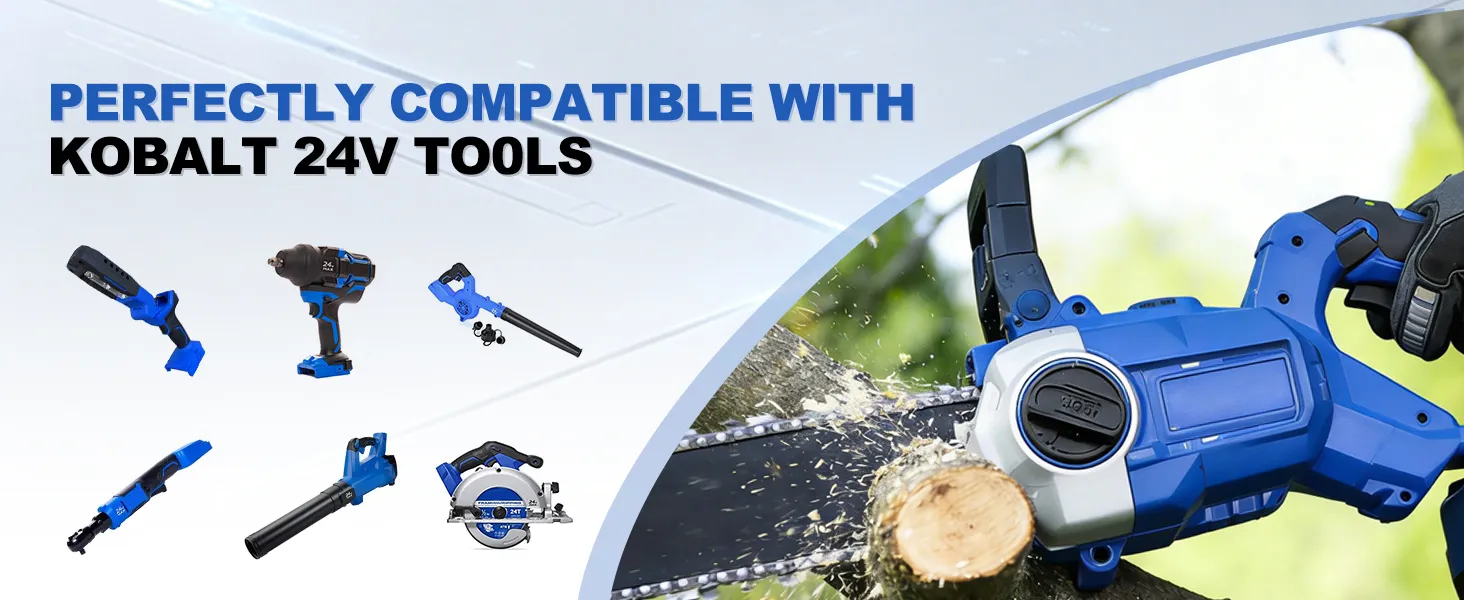
Replacement Kobalt KB624-03 KB524-03 KB424-03 KB224-03 KB124-03 24V Battery for Kobalt Tools
Capacity Selection Guide: Which Replacement to Choose?
When degradation becomes irreversible, choosing the right capacity is critical for tool performance. Kobalt 24V batteries typically come in 2.0Ah, 4.0Ah, 5.0Ah, and 6.0Ah variants. Here’s how to choose:
- 2.0Ah – 2.5Ah: Ideal for low-drain tools (work lights, fans, compact drills). Lightweight with moderate runtime.
- 4.0Ah – 5.0Ah: The “sweet spot” for most workshops. Supports circular saws, reciprocating saws, and hammer drills without excessive weight.
- 6.0Ah and above: Recommended for continuous high-draw applications (angle grinders, leaf blowers, chainsaws). Provides longer runtime but adds significant weight.
Verification standard for compatible replacements: Always ask the supplier for: (1) A cell specification sheet confirming a continuous discharge rate ≥ 15A (to match Kobalt tools), (2) BMS function list (over-charge, over-discharge, over-current, short-circuit, and thermal protection), and (3) Runtime test data under a load comparable to your primary tool.
When Should You Replace the Battery?
Replace your Kobalt 24V battery immediately if you observe:
- Severe capacity loss: Less than 50% of original runtime under light load.
- Physical deformation: Swelling, cracked casing, or leaking electrolyte.
- Persistent faults: Frequent charging interruptions that cannot be resolved by cleaning contacts or balancing cycles.
- Excessive heat: The battery reaches >60°C (140°F) within 5 minutes of charging, even at room temperature.
Common Maintenance Mistakes to Avoid
- Leaving batteries in a hot car/garage: Cabin temperatures can exceed 60°C (140°F) in summer, permanently damaging cells.
- Storing fully discharged: Even “off” batteries have a small parasitic drain; storing at 0% SOC for months leads to deep discharge failure.
- Ignoring temperature warnings: Forcing a charge when the LED flashes slowly due to temperature may cause a thermal runaway event.
- Using makeshift chargers: “Universal” lithium chargers without a dedicated Kobalt profile will ruin the BMS balance.
Frequently Asked Questions (FAQ)
Should I fully discharge my Kobalt battery before charging?
No. Never deliberately deep discharge a lithium-ion battery. Partial discharges (recharging at ~20-30% remaining capacity) significantly extend cycle life compared to full depth-of-discharge (DoD) cycles.
What is the absolute best storage condition?
Store at 19.0V – 20.0V (approx. 60% SOC), in a cool, dry location with stable temperatures between 10°C and 25°C (50°F – 77°F) and relative humidity below 65%.
Why does my Kobalt battery run only for a few minutes, but the charger says it’s full?
This is the classic symptom of high internal resistance or cell imbalance. The BMS detects the nominal voltage, but under load, the voltage sags immediately below the cut-off threshold. This usually indicates the pack is at the end of its usable life and requires replacement.
How many years does a Kobalt 24V battery typically last?
With optimal maintenance (avoiding heat, storing at 60% SOC, and preventing deep discharges), you can expect 3 to 5 years of service life. Heavy daily professional use may reduce this to 2–3 years.
Conclusion
Extending the lifespan of your Kobalt 24V battery hinges on three pillars: thermal discipline (charge between 4-40°C), voltage hygiene (avoid deep discharge and store at ~60% SOC), and diagnostic vigilance (monitor LED codes and runtime trends). By following the 7 tips and using the diagnostic table above, you can maximize your investment and avoid premature, unnecessary replacements. When performance decline becomes irreversible and safety is at risk, choose a replacement based on verified compatibility, comprehensive BMS protection, and documented test results—not just price.
Every XNJTG replacement battery/charger is tested for correct fit, charger handshake, and thermal cut-off before leaving our facility. We help you avoid the “physical fit but system fail” trap.
Get free technical consultation, sample test reports, and bulk pricing → Contact our engineering team