
Kobalt 24V Replacement Battery Guide: Compatibility & Buying 2026
This B2B guide explains how to choose a replacement battery for Kobalt 24V tools. It covers battery platform architecture, charger communication behavior, capacity selection (2.0Ah–6.0Ah), common charging failure causes, OEM vs aftermarket evaluation, and supplier validation requirements. Includes compatibility verification points, field testing recommendations, and a comparison framework. Essential for distributors and fleet operators.

- Platform compatibility matters more than voltage. Kobalt 24V tools require correct ecosystem matching—not just 24V labeling.
- Capacity (Ah) affects runtime, not compatibility. 2.0Ah to 6.0Ah batteries work within the same platform if properly designed.
- Charger communication is critical. Modern Kobalt chargers verify battery identity before charging begins.
- Temperature protection is often misunderstood. Batteries stored in cold/hot environments may appear defective until they return to normal temperature.
- Supplier validation is essential. Request charger compatibility reports, discharge curves, and batch traceability records.
📑 Contents
- 1. What Does a Kobalt 24V Replacement Battery Actually Mean?
- 2. Why Platform Compatibility Matters More Than Voltage
- 3. Kobalt 24V Battery Families and Capacity Options
- 4. Why Charger Compatibility Is Critical
- 5. Why Kobalt 24V Batteries Fail to Charge
- 6. How to Choose the Right Kobalt 24V Battery Capacity
- 7. OEM vs Aftermarket Kobalt Batteries
- 8. What to Check Before Buying a Replacement Battery
- 9. What Should Be Tested Before Battery Replacement
- 10. What a Reliable Supplier Should Be Able to Prove
- 11. Comparison: OEM vs Premium Aftermarket vs Low-Cost
- 12. FAQ
- 13. Conclusion
🔋 What Does a Kobalt 24V Replacement Battery Actually Mean?
A Kobalt 24V replacement battery is a system-compatible energy module, not just a physical power source. In real-world use, it must align with:
- Battery platform architecture
- Charger recognition protocol
- Battery Management System (BMS) logic
- Mechanical and terminal design
- Thermal protection thresholds
⚙️ Why Platform Compatibility Matters More Than Voltage
Kobalt 24V tools operate within a defined ecosystem where batteries and chargers communicate with each other.
What happens inside the system? When a battery is inserted:
- The charger checks identification signals
- The BMS evaluates temperature and voltage state
- Charging profile is selected automatically
- Safety thresholds are enforced continuously
If any part mismatches, charging may fail even if voltage appears correct.
| Misconception | Reality |
|---|---|
| 24V = universal compatibility | Different generations use different logic |
| Same shape = same battery | Internal electronics may differ |
| Any charger works | Chargers validate battery identity |
📊 Kobalt 24V Battery Families and Capacity Options
Kobalt 24V batteries exist in multiple capacity tiers within the same platform.
Common capacity options: 2.0Ah (lightweight, entry-level), 4.0Ah (general-purpose balance), 5.0Ah (extended runtime), and 6.0Ah (high-demand continuous work).
Does capacity affect compatibility? No. Capacity only impacts runtime duration, battery weight, and charging time. It does not define whether the battery will work with the tool or charger.
🔌 Why Charger Compatibility Is Critical
Charger compatibility is often more important than physical fit. Modern Kobalt chargers rely on battery identification handshake, temperature feedback loop, charge curve matching, and safety cutoff thresholds.
| Mismatch Type | Result |
|---|---|
| Protocol mismatch | No charging response |
| Thermal mismatch | Charging interruption |
| Current mismatch | Slow or unstable charging |
| Identification failure | Battery rejection |
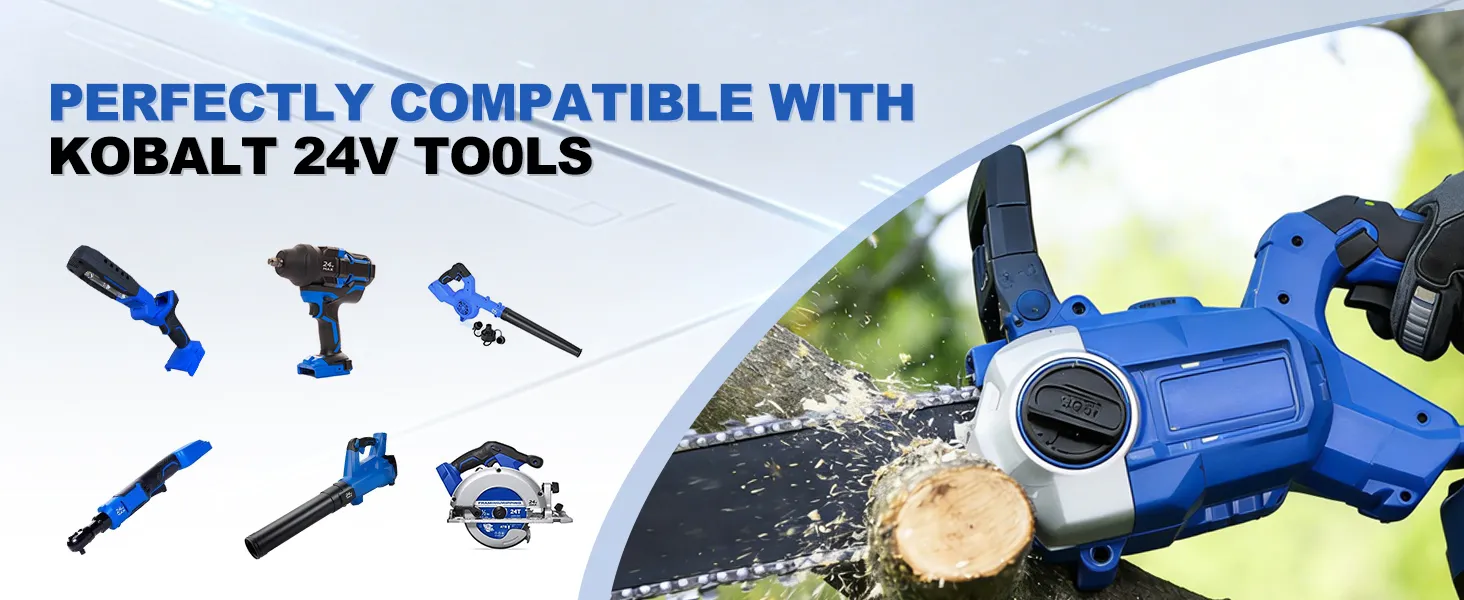
Replacement 24v Battery For Kobalt Tools
Every XNJTG replacement battery/charger is tested for correct fit, charger handshake, and thermal cut-off before leaving our facility. We help you avoid the “physical fit but system fail” trap.
Get free technical consultation, sample test reports, and bulk pricing → Contact our engineering team
❓ Why Kobalt 24V Batteries Fail to Charge
Most "battery failure" cases are system-level issues rather than cell damage.
Primary root causes: charger incompatibility or aging charger logic, deep discharge after long storage, oxidized or dirty terminals, temperature protection activation, and BMS safety lockout mode.
Common symptoms: no LED response, flashing error indicator, charging starts then stops, or battery not recognized.
⚖️ How to Choose the Right Kobalt 24V Battery Capacity
Battery selection should reflect workload requirements rather than marketing claims.
| Capacity | Runtime | Weight | Best Application |
|---|---|---|---|
| 2.0Ah | Short | Light | Small handheld tools |
| 4.0Ah | Balanced | Medium | General household use |
| 5.0Ah | Extended | Heavy | Outdoor equipment |
| 6.0Ah | Maximum | Heaviest | Continuous operation |
🏷️ OEM vs Aftermarket Kobalt Batteries
Both OEM and aftermarket batteries can perform reliably when properly engineered.
OEM advantages: verified platform integration, stable charger recognition, and predictable lifecycle performance.
Aftermarket advantages: lower cost structure, flexible capacity configurations, and OEM/ODM customization options.
✅ What to Check Before Buying a Replacement Battery
A reliable Kobalt 24V replacement battery should meet system-level compatibility requirements:
- Platform match (true 24V architecture)
- Charger compatibility validation
- Battery family consistency
- BMS protection design quality
- Thermal control behavior
- Cell grade (18650 / 21700)
- Supplier test documentation availability
🧪 What Should Be Tested Before Battery Replacement
Field validation reduces unnecessary replacement costs.
Recommended checks:
- Charger recognition test
- Cross-device compatibility test
- Terminal contact inspection
- Temperature normalization before charging
- Load runtime observation under real use
📋 What a Reliable Supplier Should Be Able to Prove
Professional battery suppliers must provide verifiable technical evidence.
Required validation documentation:
- Platform compatibility verification
- Charger behavior test reports
- Discharge curve performance data
- Internal resistance consistency records
- Thermal stability validation
- Batch traceability records
- Structured test logs for production control
📊 Comparison: OEM vs Premium Aftermarket vs Low-Cost Batteries
| Factor | OEM | Premium Aftermarket | Low-Cost Generic |
|---|---|---|---|
| Compatibility | High | High (if validated) | Unstable |
| Safety protection | High | High | Inconsistent |
| Runtime stability | Consistent | Comparable | Variable |
| Charger behavior | Reliable | Test-dependent | Unstable |
| Cost | High | Medium | Low |
❓ FAQ
Are all Kobalt 24V batteries interchangeable?
No. Compatibility depends on platform generation and charger system behavior.
Can I use a higher Ah battery on Kobalt tools?
Yes, as long as it belongs to the same platform.
Why is my Kobalt battery not charging?
Most causes include charger mismatch, deep discharge, temperature protection, or contact issues.
Do aftermarket Kobalt batteries work with OEM chargers?
Yes, if properly designed and compatibility-tested.
Does battery capacity affect tool power?
No. It only affects runtime.
🎯 Conclusion
Conclusion: Choosing a Kobalt 24V replacement battery requires system-level evaluation—platform architecture compatibility, charger communication behavior, battery family alignment, BMS protection logic, and verified supplier testing data. A replacement battery is not just a component—it is part of a closed electrical ecosystem where compatibility determines performance, safety, and lifespan.
Every XNJTG replacement battery/charger is tested for correct fit, charger handshake, and thermal cut-off before leaving our facility. We help you avoid the “physical fit but system fail” trap.
Get free technical consultation, sample test reports, and bulk pricing → Contact our engineering team