
Not All Tool Are Equal: How Your Choice Cuts Makita Battery Life Short
Not all tools treat batteries equally. Drills, grinders, hammers, and demolition tools stress cells differently, driving uneven aging, internal resistance growth, and early cutouts. Fleet reliability and pack life depend on understanding these tool-specific stress profiles, allocating the right battery types, and enforcing logging, testing, and procurement practices to maximize cycle life.
1. Why “One Battery, Many Lifes” Is a Misconception
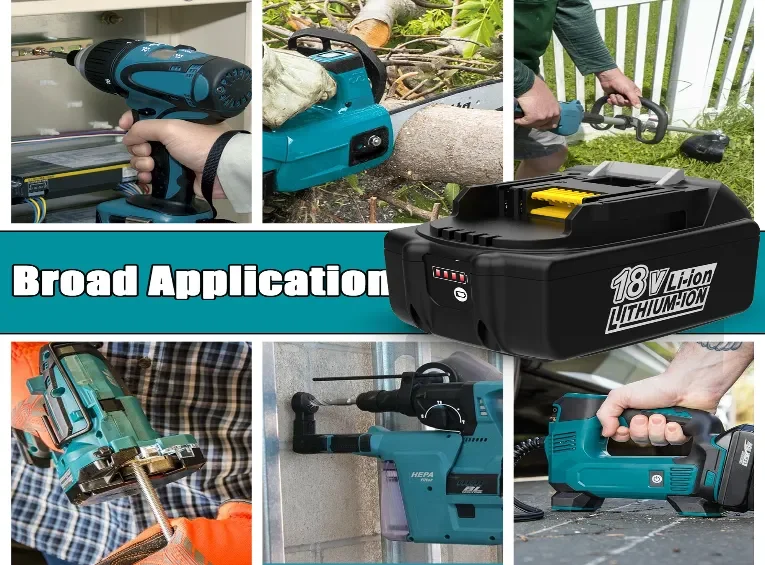
Using the same battery across different tools exposes cells to widely varying stresses. Drills, grinders, rotary hammers, and demolition tools impose unique current, thermal, pulse, and vibration profiles, all of which accelerate aging differently. Understanding these tool-specific effects is critical for intelligent battery allocation, fleet reliability, and extended service life.
2. How Tool Stress Impacts Battery Cycle Life
-
Continuous current stress: High sustained currents in grinders and saws raise internal resistance (IR) and accelerate chemical degradation.
-
Pulse current stress: Hammer drills, impact drivers, and nail guns generate repeated peak current spikes that cumulatively heat cells and exacerbate IR growth.
-
Thermal stress: Tools running at high load elevate pack temperatures, accelerating SEI growth, electrolyte decomposition, and permanent capacity loss.
-
Mechanical/vibration stress: Demolition hammers, chainsaws, and heavy-duty sanders impose mechanical shocks that may weaken welds, solder joints, or cell alignment.
3. Tool Class vs Battery Wear
| Tool Class | Examples | Stress Profile | Battery Impact |
|---|---|---|---|
| Low-stress | Drills, work lights | Steady, low current | Minimal IR growth, stable cycle life |
| Medium-stress | Impact drivers, jigsaws | Intermittent high current, moderate vibration | Moderate IR rise, slight thermal aging |
| High-stress | Grinders, circular/recip saws | Continuous high current, elevated temperature | Significant IR increase, faster capacity fade |
| Extreme-stress | Demolition hammers, large vacuums | Peak currents, continuous vibration, high heat | Rapid capacity loss, thermal hotspots, early cutouts |
4. Tool-Specific Battery Strategies
-
High/extreme-stress tools: Use Endurance or High-Performance packs with high-rate 21700 cells, reinforced thermal pathways, and robust BMS balancing circuits.
-
Medium/low-stress tools: Use Classic or Value packs with consistent cells and long calendar life; cost-effective without compromising low-load performance.
Fleet managers should map tool classes to battery types to optimize runtime, reduce unexpected cutouts, and maximize pack longevity.
5. Operational Guidelines for Enterprise Fleets
-
Assign high-performance batteries to high-load tools; reserve older or lower-grade batteries for low-stress tools.
-
Maintain per-tool battery usage logs for traceability.
-
Plan procurement volumes according to tool fleet composition, expected duty cycles, and replacement cadence.
-
Implement a rotation policy to avoid overusing specific packs on extreme-stress tools.
6. Expanded Test Protocols & Metrics
Per-cycle logging:
-
Record current, DCIR, voltage, SOC, and surface temperature.
-
Use thermal imaging during peak-load events to identify hotspots.
-
Track cutoff events and voltage sag under load.
Scheduled inspections:
-
Capacity checks every 25–50 cycles.
-
DCIR pulse testing at 20/50/80% SOC to monitor internal resistance growth.
-
End-of-shift or weekly surface temperature audits on high-stress tools.
Acceptance thresholds:
-
Capacity ≥ 80% of rated Ah.
-
DCIR increase ≤ 50% compared to baseline.
-
Cell temperature ≤ 60 °C under typical high-load operation.
-
≤2 tool cutouts per 300 cycles.
7. Data Management & Procurement Requirements
-
Maintain detailed CSV logs at the battery pack and cell level for auditing and RMA purposes.
-
Require vendor transparency: cell brand, batch codes, UN38.3 compliance, and independent safety verification reports.
-
Include RMA clauses triggered by capacity or IR deviation beyond acceptable limits.
-
Ensure warranties cover ≥80% capacity at 300 cycles; partial credit for minor deviations may be negotiated based on fleet strategy.
8. FAQ — Common Questions
-
Why do impact drivers and hammers wear batteries faster? Peak pulse currents with minimal recovery lead to cumulative I²t heating, increasing internal resistance and reducing usable capacity.
-
Can firmware extend battery life? Adaptive derating and I²t tracking can help, but tool-specific validation is required.
-
How can users prolong battery life? Allocate packs by tool type, avoid charging immediately after high-load use, rotate batteries regularly, and perform periodic full-charge/discharge cycles.
9. Advanced Fleet Recommendations
-
Implement a tool-specific battery assignment matrix to track stress exposure.
-
Introduce thermal management practices: avoid charging packs while hot, store at moderate SOC (40–60%), and prevent extreme temperature exposure in vehicles or storage.
-
Schedule pilot lots for new pack models, logging runtime, cutouts, and IR trends before wide fleet deployment.
-
Cross-reference BMS logs with usage patterns to detect early anomalies.
10. Procurement & Contract Language (Sample Clauses)
-
Suppliers must provide per-lot: batch traceability, UN38.3 certification, raw CSV per-cycle logs, thermal mapping, DCIR pulse data, and golden-unit references.
-
Warranty must cover imbalance or early degradation events, with clear RMA procedures for failing lots.
-
Acceptance testing should include thermal imaging, pulse IR, capacity verification, and tool-specific high-load trials.
11. 60-Second Field SOP for Battery Triage
-
Observe battery symptoms (cutouts, sag, overheating).
-
Conduct immediate safety check (hot, swelling, smoke).
-
Run quick swap tests on known-good tools.
-
Capture DCIR pulse and OCV spread if available.
-
Escalate to bench testing for unresolved anomalies.
-
Apply warning, action, or retirement thresholds and quarantine affected packs.
12. Conclusion & Next Steps
Battery cycle life is highly tool-dependent. Intelligent allocation, robust logging, strict procurement requirements, and adherence to operational best practices can extend pack lifespan, improve fleet reliability, and reduce total cost of ownership. Prioritize fleet-specific pilot tests and vendor transparency to make informed replacement and rotation decisions.