
OEM vs. Third-Party Drill Batteries: A 2026 Buyer’s Guide
This B2B guide helps distributors, importers, and procurement teams choose between OEM and premium third-party cordless drill batteries. It moves beyond brand popularity to focus on measurable criteria: platform compatibility, cell quality, BMS design, thermal management, charger communication, and batch consistency. Using real metrics and a supplier verification checklist, the article explains how to reduce warranty claims and total ownership cost. It includes comparison tables for DeWalt, Milwaukee, Makita and Bosch ecosystems, plus a customer case showing 62% lower return rates after switching to a verified third-party supplier.

- 1. Introduction: OEM or Replacement?
- 2. What “Best Battery Brand” Actually Means
- 3. Platform Compatibility: The First Filter
- 4. Reliability: Cell Quality, BMS & Thermal Management
- 5. OEM vs. Premium Third-Party Value Analysis
- 6. What Evidence to Request Before Bulk Orders
- 7. What Defines a Premium Third-Party Supplier?
- 8. Final FAQ for Procurement Teams
- 9. Conclusion & Strategic Recommendations
🔋 Introduction: OEM or Aftermarket — Which One Fits Your Supply Chain?
When a cordless drill battery reaches end-of-life, procurement teams face a critical decision: purchase original (OEM) batteries from tool manufacturers or source high-quality replacement batteries from specialized third-party suppliers. The challenge? Battery quality cannot be judged by brand logos alone.
A DeWalt battery, Milwaukee battery, Makita battery, or Bosch battery all deliver solid performance inside their native ecosystems. But premium third-party alternatives now offer near-OEM reliability at lower total ownership cost — provided you verify compatibility, BMS integrity, thermal performance, and manufacturing consistency. This guide gives you an evidence-based framework to reduce warranty claims and build a profitable, reliable battery program.
📌 What “Best Battery Brand” Really Means in B2B Procurement
“Best” depends on your priorities. Instead of marketing hype, focus on: platform compatibility, runtime stability, voltage sag, charger handshake, cycle life, supply continuity, and warranty support. A low-cost generic battery may seem cheap, but poor cell quality and weak BMS often double long-term costs through early failures and tool damage risks.
⚙️ Platform Compatibility: The Non-Negotiable First Filter
Batteries, chargers, and tools function as a complete ecosystem. Compatibility failures (e.g., charger rejection, short runtime, overheating) are the #1 reason for returns in the aftermarket.
DeWalt Battery Ecosystem
20V MAX and FLEXVOLT families: FLEXVOLT batteries automatically switch voltage (20V/60V/120V) for high-demand tools. Third-party batteries must replicate proprietary communication logic to avoid charger rejection.
Milwaukee Battery Platform
M12™ (compact) and M18™ (heavy-duty) lines incorporate advanced REDLINK™ Intelligence — a sophisticated battery management system that authenticates cells and monitors temperature. Compatible replacements must undergo rigorous charger validation.
Makita Battery Heritage
Makita’s 18V LXT remains one of the world’s largest cordless ecosystems. Trusted by contractors worldwide, Makita batteries set benchmarks for runtime consistency and charger stability.
Bosch Professional & AMPShare
Bosch batteries are engineered for industrial applications with superior thermal management. The AMPShare alliance expands cross-brand compatibility.
| Battery Brand | Major Platform | Key Strengths | Typical Users |
|---|---|---|---|
| DeWalt Battery | 20V MAX / FLEXVOLT | Large ecosystem, strong runtime, broad adoption | Construction pros |
| Milwaukee Battery | M12 / M18 | Advanced electronics, HIGH OUTPUT™, FORGE™ tech | Industrial / infrastructure |
| Makita Battery | 18V LXT / 40V XGT | Platform maturity, global support, reliability | General contractors |
| Bosch Battery | Professional 18V / AMPShare | Thermal management, industrial focus | Manufacturing & workshops |
Choosing an ecosystem directly affects future tool expansion and charger compatibility — a strategic decision for any procurement manager.
🔬 What Makes a Battery Brand Truly Reliable?
🔋 Cell Quality & Consistency
Premium cells (Grade A from Samsung SDI, LG Energy, Murata) offer lower internal resistance and higher cycle life. Counterfeit or Grade B cells cause capacity fade after 50-100 cycles.
🧠 Battery Management System (BMS) Design
Robust BMS includes overcharge, over-discharge, overcurrent, and temperature protection. Premium third-party batteries replicate OEM’s charge algorithm to ensure safe charger interaction.
🌡️ Thermal Management & Heat Dissipation
Excessive heat degrades lithium cells. Good designs use nickel-plated busbars, temperature sensors, and housing ventilation. Request thermal imaging or temperature rise test data.
📦 Manufacturing Consistency
Batch-to-batch variation kills reliability. Look for ISO9001 certified lines, in-process inspections, and final capacity audits.
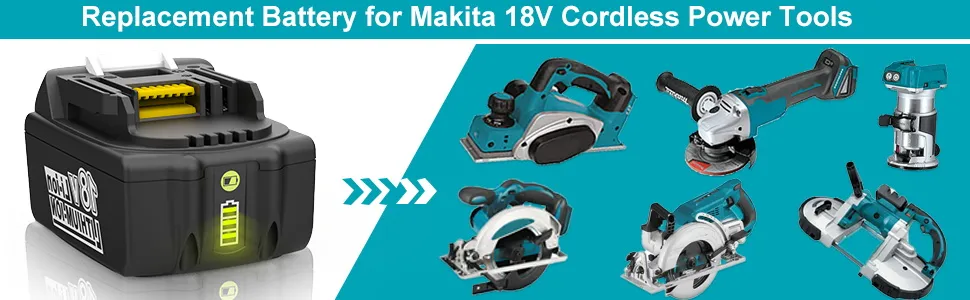
Replacement Makita 18v Lxt Battery For Makita Lxt Power Tools
💰 OEM Battery vs. Premium Replacement: Which Delivers Better Value?
| Criteria | OEM Battery | Premium Third-Party Battery |
|---|---|---|
| Purchase cost | High (often 1.5–2.5x) | 30–50% lower |
| Compatibility risk | Virtually zero | Supplier dependent — must validate |
| Runtime stability | Excellent | Good to excellent (with A-cells & BMS) |
| Warranty support | Brand-backed (1–3 years) | Supplier-backed (1–2 years typical) |
| Bulk purchasing flexibility | Limited, rigid distribution | High — direct OEM/ODM options |
| Private label / white label | No | Common for B2B partners |
📋 What Evidence Should Suppliers Provide Before Bulk Orders?
Stop relying on marketing claims. Require objective documentation:
- 🔌 Compatibility verification logs: proof of testing on OEM chargers (e.g., DeWalt DCB118, Milwaukee M12/M18 chargers, Makita DC18RC).
- ⚡ Capacity test reports: discharge curves at 0.5C/1C rates, internal resistance values (milliohm consistency).
- 🌡️ Thermal performance records: temperature rise under load (<15°C delta vs ambient).
- 🏭 Batch consistency controls: incoming material inspections, in-line BMS functional tests, final aging records.
- 🔍 Traceability system: batch numbers linking production records to corrective actions.
🏭 What Defines a Premium Third-Party Battery Supplier?
The best replacement battery manufacturers follow engineering practices similar to OEMs. Look for:
- Grade A lithium cells (verified via cell qualification documents and supplier codes).
- Advanced protection & communication ICs (e.g., TI BQ series, Renesas, or Mitsumi).
- Charger compatibility validation — cross-test on 15+ charger models.
- Batch-level quality control with statistical process control (SPC).
- Technical documentation (UN38.3, MSDS, CE, RoHS, and product liability insurance).
Premium suppliers also support private labeling, stable monthly capacity (50k+ units), and after-sales tech support.
After switching to a verified premium third-party supplier (with full compatibility reports and A-grade cells), an Italian tool distributor reduced battery-related returns from 11.4% to 4.3% within 9 months while improving margins by 22%.
❓ Final FAQ for Procurement & Sourcing Teams
Which battery brand lasts the longest — OEM or aftermarket?
Lifespan depends on cell quality and charge/discharge habits. Premium OEM and top-tier third-party batteries both achieve 500+ full cycles. Low-cost generics often fail before 200 cycles.
Can aftermarket batteries damage my cordless drills or chargers?
Only if the BMS is poorly designed (missing protection or wrong communication). Premium third-party batteries with validated charger compatibility pose no risk. Always ask for safety certification.
Why do some aftermarket batteries fail charger recognition?
OEM chargers use data pins to communicate with the battery's BMS. Incomplete or cloned firmware causes 'defective pack' errors. Ask supplier for charger test matrix.
Is a higher Ah (capacity) battery always better?
Not necessarily. Higher Ah adds weight and size. Balanced capacity (e.g., 4.0Ah–6.0Ah for drills) often offers the best runtime/weight ratio. Prioritize verified capacity over inflated labels.
How can distributors reduce warranty claims for batteries?
Source from suppliers that provide batch traceability, pre-shipment inspection (PSI), and 18-month warranty. Educate end-users on proper charging (avoid extreme temperatures).
🎯 Conclusion: Building a Reliable Battery Supply Program
The "best cordless drill battery brand" is not about popularity — it's about proven compatibility, consistent cell quality, robust BMS, and transparent manufacturing data. A DeWalt battery, Milwaukee battery, Makita battery, or Bosch battery each excel when paired with its native system. Simultaneously, premium third-party batteries offer compelling value when backed by verification documents, stable production, and warranty commitment.
For importers, distributors, and repair networks, shifting from blind brand loyalty to evidence-based sourcing lowers total cost, reduces returns, and builds end-customer trust.