
Preventing Charger-Induced Stress on Makita BL-Series Batteries
Chargers can be a primary cause of premature battery aging or failure when their hardware, firmware, or use patterns induce excess voltage, current, heat, or ripple into BL-series packs. This guide explains how chargers stress BL packs, practical preventive design/operational controls, reproducible tests (field → bench → lab) to detect charger-driven damage, and clear troubleshooting/mitigation steps you can apply immediately. Technical, non-marketing, and suitable for engineering, QA and fleet operations.
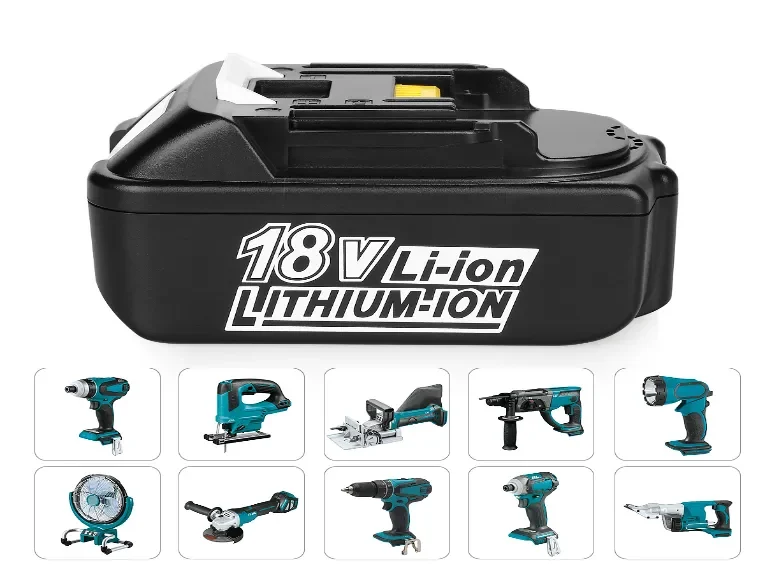
Chargers that push excessive current, apply incorrect CV/termination, lack proper thermal sensing, present high ripple, or run flawed firmware are a primary cause of premature aging and failures in Makita BL-series battery; preventing charger-induced stress requires conservative CC–CV control, accurate pack/cradle temperature sensing, low-ripple outputs and formal acceptance tests.
Safety first
-
If a pack or charger smokes, vents, swells, or smells burned, stop, isolate outdoors on a non-combustible surface and QUARANTINE. Do not attempt recovery or live disassembly.
-
When powering or probing chargers use an isolation transformer, differential probes or isolated meters and RCD/GFCI. Mains-side work is hazardous.
-
Never bypass BMS protection or short pack terminals to “test” — that can cause thermal runaway. All cell-level teardown or high-energy tests belong in an instrumented lab with blast containment.
How chargers cause stress — mechanisms to watch
-
Excessive charge current / poor current control: prolonged over-current or incorrect CC setpoints increase I²R heating and shorten life.
-
Incorrect charge algorithm or termination (overvoltage / early cutoff): wrong CV setpoint or abrupt termination causes overcharge, imbalance, or a false “full” reading that masks low capacity.
-
Thermal coupling/poor sensing: charger that can’t sense pack temperature properly (bad thermistor placement or missing cradle sensor) may continue high-power charging while pack overheats.
-
High ripple / poor smoothing: excessive high-frequency ripple stresses cells, increases local heating and can accelerate separator/electrolyte degradation.
-
Handshake/ID mismatch and partial-charge behavior: chargers stuck in wake/trickle mode for long periods or that repeatedly start/stop can cause repeated partial cycles and calendar stress.
-
OV/UV events or spikes: transient overvoltage, mains surges, or feedback failures can expose cells to harmful voltages.
-
Contact resistance / connector heating: charger/contact designs that generate localized heating at terminals cause local cell heating and poor contact life.
-
Firmware bugs / repeated aggressive fast-charge cycles: controller logic that ignores thermal derates or failsafe limits increases cumulative stress.
Indicators that a charger is stressing packs (field signs)
-
Pack surface or pack-group temperature rises quickly during charge (IR > recommended).
-
Packs that show early “full” but low runtime (SOC misreporting).
-
Rapid DCIR increase or capacity loss after repeated charging on a single charger model.
-
Repeated BMS trips (overtemp/OVP) coincident with a particular charger.
-
Visible terminal discoloration, connector heating, or swollen cases after continued charging.
Preventive design & operational controls
Charger hardware & firmware (engineering controls)
-
Implement true CC–CV with accurate CV setpoint and controlled taper; limit max charge current to a conservative spec for BL packs unless explicitly qualified.
-
Use proper thermal sensing: read pack thermistor plus a cradle/MOSFET/heatsink sensor; implement
max(pack_temp, charger_temp)derate logic. -
Add soft-start / precharge to limit inrush into capacitors and connector arcs.
-
Design low ripple (adequate smoothing caps, LC filtering) and set ripple specs in acceptance testing.
-
Include robust OVP, UVP and surge protection (TVS/MOV) and safe firmware fallback (refuse or trickle when sensors fail).
-
Provide handshake/ID verification and avoid forcing full current without comms when pack checks fail.
-
Log charge events and faults (timestamps, I(t), V(t), temps) for RMA traceability.
Charger assembly & manufacturing controls
-
Use low-ESR, high-temperature electrolytics sized for life and ripple current.
-
Validate feedback loop stability (no-load → load transients) and ensure no oscillatory behavior.
-
AOI for feedback components (optocoupler / TL431) and PTH solder integrity in power paths.
-
Thermal potting/heatsinking of MOSFETs and routing to minimize hotspot transfer to user surfaces.
Fleet & operational policies
-
Prefer OEM or vendor-qualified chargers; require charger qualification tests for third-party models.
-
Schedule forced cooldown windows for packs after heavy fast-charging; avoid immediate reuse in hot environments.
-
Rotate chargers across fleet to avoid single-charger wear patterns.
-
Log charger firmware versions and require updates that fix safety/derate bugs.

For Makita 18v Power Tool Battery
Reproducible test protocols (field → bench → lab)
Field (fast checks)
-
Swap test: charge suspect pack on known-good charger; charge known-good pack on suspect charger. If failure follows charger → charger suspect.
-
Charge current clamp: measure charging current profile with clamp/Hall sensor; check expected CC plateau and CV taper.
-
IR snapshot: measure pack surface temp at 1, 5, 15 minutes into charge; compare against allowed delta.
-
Charge log spot: capture charge start/end voltage, current and elapsed time (use charger log or external recorder).
Bench (instrumented, safe)
-
Charge curve capture: log V(t), I(t), pack temp at high sample rate through entire CC–CV cycle; look for spikes, ripple, or unexpected tapering.
-
Ripple & switching analysis: use differential scope to measure DC ripple at battery terminals and switching node behavior under load. Compare to golden unit.
-
Thermal soak test: run repeated charge cycles and IR-map pack and charger to detect creeping hotspots.
-
Current foldback & transient response: apply step loads to charger output (or connect/disconnect battery simulation) to ensure controller stability.
Lab (forensic / qualification)
-
EIS / ICA on cells before/after controlled charging to detect increased impedance or loss of active lithium attributable to charger behavior.
-
Accelerated calendar & cycle tests comparing chargers (e.g., OEM vs aftermarket) to quantify DCIR growth and capacity fade over N cycles.
-
Surge and transient immunity tests per IEC standards; verify sacrificial protection behavior.
-
Firmware stress tests: force sensor failure modes and verify charger fallback behavior.
Troubleshooting flow (copy/paste response)
-
Safety triage: smell/heat/swelling? → QUARANTINE.
-
Swap test: isolate charger vs pack.
-
Capture charge V/I/T logs on suspect charger for a full charge cycle.
-
If charger shows overcurrent/OV events or high ripple → bench SMPS and feedback inspection (caps, opto, TL431, MOSFETs).
-
If charge curve looks normal but packs age quickly → run EIS/ICA on pack cohorts charged on the suspect charger vs known-good chargers.
-
Replace or retire chargers failing bench acceptance; update fleet policies.
Practical mitigations you can apply right away
-
Enforce charger qualification: only use chargers that pass charge-curve, ripple, and thermal acceptance tests you define.
-
Add simple field logging: require chargers to record per-cycle max temp, peak current and CV setpoint for a rolling sample to spot drift.
-
Limit ambient charging temp: avoid charging above ~40 °C; implement charger ambient derate or refuse-to-charge thresholds.
-
Clean contacts & inspect: reduce contact resistance—common, low-cost cause of localized heating.
-
Prefer chargers with conservative CV & derate setpoints for fleet use when long life is prioritized over fastest possible charge time.
Summary — one-line takeaway + 3 immediate actions
Chargers stress BL packs when they push excessive current/voltage, allow thermal runaway, present high ripple, or run faulty control logic; prevent this with correct charger design, thermal sensing, stable CC–CV control, acceptance testing and fleet rules.
Immediate actions:
-
Swap a suspect charger with a known-good unit and log one full charge cycle (V/I/T).
-
Run an IR check on a recently charged pack and charger — mark any hotspot > recommended temp for investigation.
-
If using third-party chargers fleet-wide, require a basic qualification: charge-curve capture, ripple spec test, and thermal soak pass before deployment.
FAQ
Q — Can a charger with the “correct” voltage still harm a pack?
A — Yes. Even with correct nominal CV, excessive current, high ripple, bad thermal sensing, or unstable SMPS behavior can cause localized heating and accelerated aging.
Q — How much ripple is acceptable on the battery terminals?
A — Keep DC ripple low; target ripple <100–200 mVpp for most tool chargers (tighten spec based on cell supplier guidance). Measure under charge current and at point-of-load.
Q — My charger only gives trickle/wake current — does that stress the pack?
A — Extended trickle/wake itself is mild, but repeated long partial charges and long stays in trickle (without completing a full CC–CV cycle) can encourage imbalance and calendar stress. Investigate handshake behavior.
Q — Is faster charge always worse?
A — Faster charging increases stress (higher I and more heat). If charger and pack are qualified for high-rate charging with adequate thermal design, it can be acceptable, but life tradeoffs exist — test to quantify.
Q — How to qualify a third-party charger quickly?
A — Capture one CC–CV charge curve with V(t), I(t) and T(t); measure terminal ripple with differential probe; run a 3-cycle thermal soak; if all match OEM/golden behavior within defined margins, accept for limited pilot use.