
Ryobi 18V Replacement Batteries – B2B Buying Guide (2026)
A comprehensive B2B guide to Ryobi 18V replacement batteries. Covers original packs, high-capacity/high-performance options, and third-party compatible batteries. Includes technical specifications (cell type, cycle life, discharge current, ID resistor), a 6-step test checklist, certification requirements (UL, CE, UN38.3), batch consistency validation, and a decision matrix for wholesalers, repair shops, and private-label brands.

For B2B buyers, the best Ryobi 18V replacement battery depends on your channel and risk tolerance. Original packs offer the safest compatibility but lower margin. High-capacity originals serve professionals needing longer runtime. Rigorously tested compatible batteries provide margin control and supply flexibility – if the supplier proves batch consistency and charger matching. Private-label brands benefit from OEM/ODM compatible solutions. The deciding factors must always be: platform fit, charger matching (including ID resistor), thermal performance, batch consistency, and certified compliance (UL, CE, UN38.3).
📌 Key Takeaways for B2B Buyers
- Ryobi ONE+ platform is standardized – but not all aftermarket batteries perform equally.
- Test before bulk order – fit, runtime, charger compatibility, and batch consistency are non‑negotiable.
- Certifications matter – UL, CE, UN38.3; ask for lab reports, not just paper declarations.
- Compatible batteries make business sense when the supplier provides technical data and sample validation.
- Charger matching is often overlooked – a battery that fits the tool may still fail the charger.
Introduction: More Than Just Voltage
Choosing the best Ryobi 18V replacement battery for B2B use isn’t about picking the highest Ah or lowest price. For distributors, repair chains, and private‑label brands, the real questions are: Will it work reliably across hundreds of tools? Will it charge without errors? Will the next batch behave the same?
Ryobi states that its 18V batteries are compatible with any RYOBI 18V ONE+ tool, and its chargers are designed for the ONE+ battery family. But when sourcing aftermarket alternatives, B2B buyers must verify compatibility as a system – tool, battery, and charger together.
✅ According to Ryobi’s official ONE+ documentation, the platform includes 300+ compatible products. However, third‑party batteries can deviate in BMS communication, cell quality, and thermal design. Always test with the exact tool and charger models your customers use.
Why Legacy 18V Batteries Are Still a B2B Sourcing Challenge
Even though Ryobi’s ONE+ platform is current, B2B buyers face several real‑world headaches:
- Physical fit variations – Some aftermarket shells have slightly different locking tabs or rail tolerances.
- Charger handshake failures – Missing or incorrect identification resistors cause Ryobi chargers to blink error codes.
- Batch inconsistency – Low‑cost suppliers may change cells or BMS boards without notice, leading to returns.
- Thermal shutdown under load – Poor heat management can cut power after 2 minutes in a circular saw or reciprocating saw.
For wholesalers and repair shops, a battery that “looks acceptable” on paper can still cause complaints if it runs hot, fits loosely in cold weather, or fails to charge after a few cycles.
Option 1: Original Ryobi Replacement Batteries
Best for: Buyers needing zero compatibility risk for small, short‑term orders.
| Pros | Cons |
|---|---|
| Guaranteed drop‑in fit | Higher cost per Ah |
| Works with all ONE+ chargers | Lower margin for resale |
| No end‑user confusion | Supply less flexible for bulk |
When to avoid: If you need cost‑effective monthly volumes for resale or long‑term inventory – original packs limit your margin and sourcing agility.
Option 2: High‑Capacity or High‑Performance Original Batteries
Ryobi offers batteries like 4Ah, 5Ah, and 6Ah versions. High‑capacity extends runtime; high‑performance (e.g., HP series) adds output stability for demanding tools like saws and grinders.
B2B reality check
- High‑capacity is great for contractors but adds weight.
- High‑performance costs more – suitable for professional fleets.
- Both are original, so compatibility is not an issue, but margin is lower.
Option 3: Compatible (Third‑Party) Replacement Batteries
Best for: Wholesalers, private‑label brands, and high‑volume repair chains that need margin control and stable supply.
A good compatible battery must do more than fit the slot. It should deliver:
- Stable runtime under real‑world load
- Controlled temperature rise
- Reliable BMS protection (overcurrent, overcharge, short‑circuit, thermal control, cell balancing)
- Consistent batch‑to‑batch performance
📊 Technical specifications to ask for (5Ah pack example)
| Parameter | Recommended threshold | Why it matters |
|---|---|---|
| Cell type | 18650 or 21700 (branded: Samsung, LG, Murata) | Grade‑A cells last longer, run cooler |
| Cycle life | ≥300 cycles to 80% capacity (IEC 61960) | Predictable replacement cycles |
| Max continuous discharge | 20A (drills), 30A (saws) | Supports heavy tools without cutoff |
| Temperature rise | ≤15°C above ambient after 10 min @20A | Prevents thermal shutdown |
| IR variation (batch) | ≤3% across 20 samples | Batch consistency = fewer returns |
| Charge identification resistor | Correct value for Ryobi charger (typically 10kΩ) | Avoids blinking error lights |
- Plastic shell shrinkage → loose fit in cold environments → intermittent connection.
- Wrong / missing ID resistor → Ryobi charger refuses to charge (flashing red/green).
- Poor BMS thermal management → battery shuts down after 2 minutes under heavy load (e.g., Ryobi P515 circular saw).
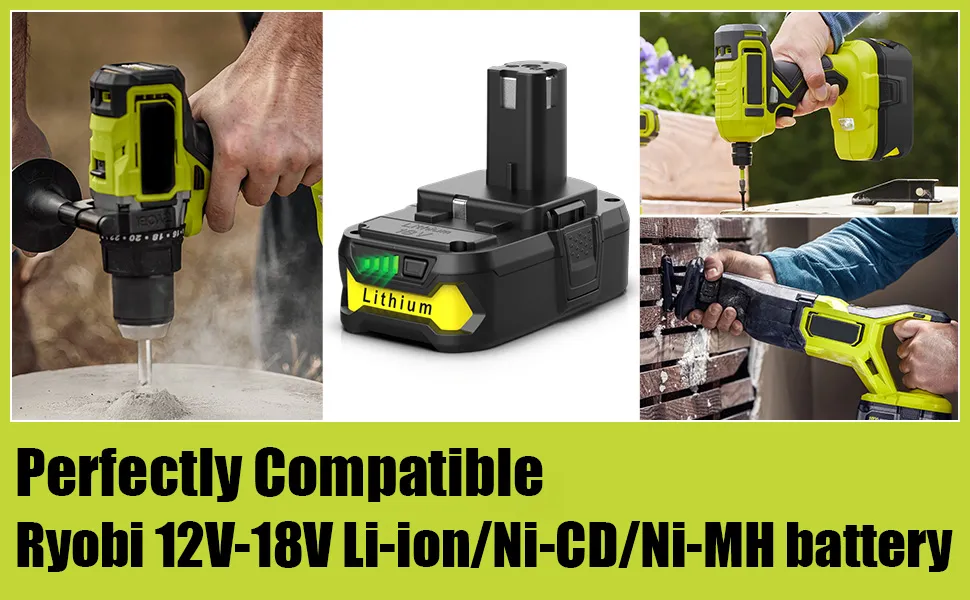
Replacement Ryobi 18v One+ Battery For Ryobi One+ Power Tools
How to Test Ryobi Replacement Batteries Before Bulk Order
- Fit & lock‑in – Insert and remove 10 times. Must click firmly, no wobble.
- Cold soak fit – Store at -10°C for 4 hours, then re‑insert. Should not loosen.
- Runtime under real load – Continuous drilling in 2x4 lumber or sawing until low‑voltage cutoff. Compare to an original Ryobi pack.
- Temperature rise – Measure case temp after 10 minutes at 20A discharge (use a dummy load or a heavy‑draw tool).
- Charger compatibility – Test with at least three Ryobi charger models (e.g., P118, P117, P135). Record any error flashes.
- Batch consistency – Randomly sample 20 units from 3 different production lots. Measure internal resistance and capacity.
Who Benefits Most From Each Path?
| Replacement Path | Best B2B Buyer Type | Main Risk | Action Item |
|---|---|---|---|
| Original Ryobi pack | Small repair shop, one‑off sale | Low margin | Keep limited stock |
| High‑capacity original | Contractor supply, retail | Higher cost | Use for premium offering |
| Compatible (third‑party) | Wholesaler, private label, high‑volume repair | Batch inconsistency | Enforce test checklist + COA |
| Custom OEM/ODM | Private‑label brand | Development lead time | Require cell certs & BMS validation |
🔒 Certifications & Compliance for Imported Batteries
If you source compatible Ryobi batteries internationally, require the following certifications based on your market:
- North America – UL 2054 (household), UL 62133 (industrial), UN38.3 (transport)
- Europe – CE, RoHS, REACH, IEC 62133
- Japan / Korea – PSE, KC
- Global shipment – UN38.3, MSDS
B2B Buyer Decision Matrix
| Your business priority | Recommended path |
|---|---|
| Lowest compatibility risk | Original Ryobi battery |
| Best margin + supply control | Rigorously tested compatible battery (with BMS validation) |
| Long runtime for professionals | High‑capacity (5Ah–6Ah) original or premium compatible |
| Brand ownership / private label | OEM/ODM compatible with custom shell and packaging |
When Does a Compatible Battery Make Business Sense?
Compatible batteries are not necessarily lower quality – they are a different value proposition. They make sense when:
- You need cost control for resale channels (e‑commerce, flea markets, hardware stores).
- You want margin flexibility – compatible packs often have 30–50% lower landed cost.
- You are building a private label brand – easy to customize with your logo and color.
- You support legacy tools where original supply is limited.
- You have testing capacity to validate suppliers.
For B2B buyers, a good compatible battery is not a compromise – it’s a strategic choice if the supplier can prove consistency.
Most Common FAQ
Q: Are all Ryobi 18V batteries compatible with all ONE+ tools?
A: Ryobi states yes for original batteries. For compatible aftermarket, you must verify – some clones fail on high‑draw tools or specific chargers.
Q: How do I verify if a compatible battery has genuine UL certification?
A: Ask for the UL file number and cross‑check it on UL’s online database. Avoid “UL‑style” or “UL compliant” wording.
Q: What is a typical MOQ for custom Ryobi‑compatible batteries?
A: For branded cells and full certifications, expect 500–1000 units. Lower MOQs (100–200) usually indicate lower‑grade cells or limited testing.
Q: Why does charger compatibility fail so often?
A: Ryobi chargers use an identification resistor to detect battery type. Many aftermarket batteries omit or use the wrong value, causing a blinking error.
Q: Can I get a sample pack for testing before bulk order?
A: Reliable suppliers always offer samples. Run the 6‑step checklist and ask for a batch consistency report.
Final Conclusion: Choose by Business Goal, Not Just Voltage
The best Ryobi 18V replacement battery path depends on your channel and risk tolerance:
- Safest compatibility → Original Ryobi (but lower margin)
- High runtime needs → High‑capacity original or premium compatible
- Margin & supply control → Rigorously tested compatible battery with BMS validation
- Private‑label brand → OEM/ODM compatible with custom design
For B2B buyers, the deciding factors should always be: platform fit, charger matching, thermal performance, batch consistency, and certified compliance.
Need Help With Ryobi‑Compatible Battery Sourcing?
If you are evaluating wholesale Ryobi 18V compatible batteries and need:
- ✅ Sample testing (with test report)
- ✅ Batch consistency validation
- ✅ Custom BMS or cell configuration (Samsung/LG/Murata)
- ✅ Certifications (UL, CE, KC, UN38.3)
We support OEM/ODM projects for power tools, garden tools, and vacuum batteries.
👉 Contact our B2B team for a sample kit and a technical datasheet.