
Safety Mechanisms in Makita Charger PCBAs — Thermal & Electrical Protections
Modern Makita-style chargers embed multiple thermal and electrical safety mechanisms on the PCBA to protect cells, users and the charger itself. These include temperature sensing and thermal cutbacks, overcurrent/current-limit, overvoltage/OVP clamps, reverse-polarity detection, input surge protection, NTC/thermistor handshakes with packs, watchdogs and hardware failsafes (fuses/TVS/crowbar). This note explains each mechanism, how it behaves, reproducible tests you can run now, bench forensic methods, common failure modes and practical mitigations.

Safety first (must-read)
-
If a charger smokes, emits burning odor, leaks, or becomes excessively hot, unplug immediately and QUARANTINE on a non-combustible surface. Do not power or open unless qualified, with an isolation transformer and PPE.
-
Mains-side parts are lethal — when measuring live SMPS nodes use differential probes/isolated meters and RCD/GFCI.
-
Never bypass safety parts (fuses, TVS, interlocks) to “force” operation — that creates serious fire risk.
Core thermal protections (what they are & why they matter)
1. Pack thermistor handshake & cradle thermistor
Charger reads the pack thermistor (NTC) and often uses a cradle-mounted sensor as a cross-check. Charger reduces charge current or refuses charge if pack temp is out of safe range. Proper placement and sensing win: pack overtemp, or missing thermistor → trickle/wake only or no-charge.
2. Charger internal MOSFET / heatsink temperature sensing
Thermistor on MOSFET tab or heatsink monitors switcher junction/thermal path. On high internal temps the charger derates charge current or stops charging to protect components.
3. Ambient/air inlet sensing & thermal throttling
Ambient or inlet/outlet sensors detect blocked airflow or high room temperature and reduce or stop charge to prevent runaway in extreme ambient conditions.
4. Thermal fuse / thermostat (sacrificial)
Some chargers include thermal fuses or thermostats that blow/open at extreme temperatures as a last-resort physical cutoff.
Core electrical protections (what they are & why they matter)
1. Overvoltage protection (OVP) & secondary-side MOSFET disconnect
Closed-loop SMPS regulation plus a secondary MOSFET or disconnect isolates output on fault. OVP prevents excessive pack voltage if feedback or regulation fails.
2. Overcurrent / current-limit & soft-start
Current-sense resistor, amplifier and firmware/hardware loops enforce a nominal charge current and implement soft-start. Foldback or thermal/current limiting protects charger and pack during fault or high-temperature conditions.
3. Input surge protection & sacrificial parts (MOVs, TVS, fusible elements)
MOVs/TVS diodes and input fuses protect against mains transients. After a severe surge these parts may be partially damaged and cause unexpected behavior — treat such chargers as suspect.
4. Reverse polarity & insertion detection
Polarity sensing prevents charging with reversed pack wiring or incorrect adapter; typically implemented with sense resistors, MOSFET orientation and logic checks.
5. Isolation & creepage design (safety by layout)
Primary–secondary isolation, sufficient creepage distances, and reinforced insulation reduce risk of user-accessible output becoming hostile under failure.
6. Crowbar & clamp devices (last-resort)
SCR or TVS crowbar circuits can clamp and force faulted outputs to ground; these usually sacrifice a fuse and prevent sustained overvoltage.
7. Watchdog, MCU fault monitoring & safe-default behavior
MCU or controller detects invalid feedback (open opto, TL431 mismatch) and reverts to safe shutdown or trickle mode rather than full-power output.
How protections act in common fault cases
-
Feedback open / regulator error → charger enters safe shutdown or crowbar/fuse triggers rather than sustained overvoltage (if designed correctly).
-
Mains surge → MOV/TVS absorb pulse; if degraded the charger may act intermittently or have unstable regulation.
-
Pack thermistor missing or out-of-range → charger enters wake/trickle/lockout mode.
-
MOSFET overheating → charger derates current or shuts down until cooled; repeated trips indicate cooling or component issue.
-
Connector short / bad contact → contact heating detected as local thermal rise and charger may shut down or show fault LED.
Reproducible field triage (quick ordered checks)
-
Visual & smell: unplugged; inspect for bulged caps, burnt parts, or broken components — if any → QUARANTINE.
-
Swap test: known-good battery into suspect charger and suspect battery into known-good charger to isolate. Photograph LED states.
-
Outlet verification: test charger on a different outlet to rule out mains instability.
-
Contact cleaning & retest: clean charger cradle and battery terminals, reseat and observe charge behavior.
-
Short warm-up test: with known-good battery, run a short charge session and monitor surface temperature and LED behavior.
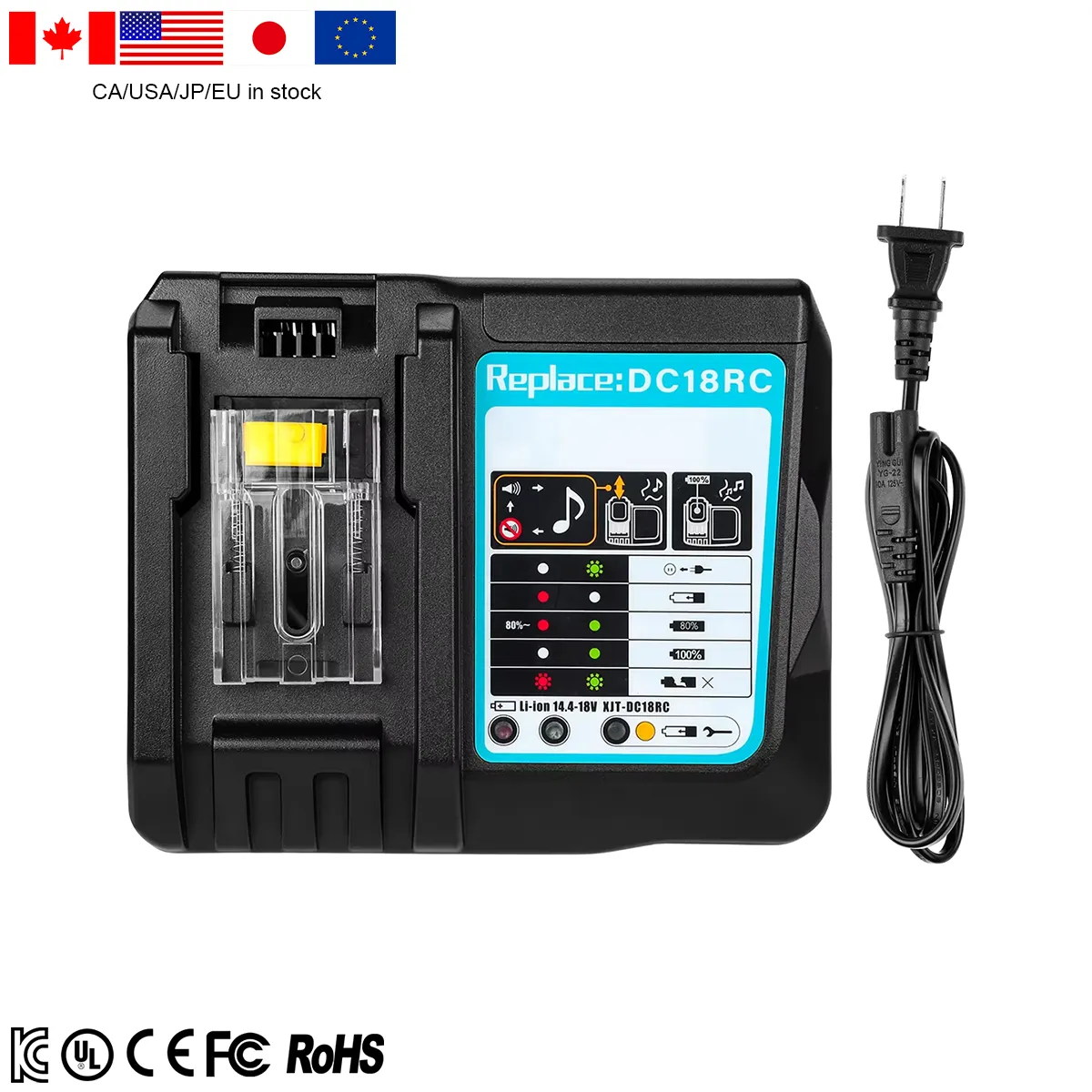
DC18RC Rapid Charger For Makita 14.4V-18V Li-ion Battery 3A
Bench-level diagnostics (safe, instrumented procedures)
Prerequisite: isolation transformer, differential probes or isolated meter, RCD/GFCI.
A. No-load output behavior
-
Power charger with no battery attached (some chargers require battery handshake). Observe secondary open-circuit voltage carefully using isolated instruments. Unexpected high DC indicates feedback failure — power off immediately.
B. Load regulation test
-
Connect an electronic load set to expected charge current; observe voltage/current stability and thermal behavior (MOSFET temps). Foldback, instability or excessive ripple point to SMPS or smoothing cap issues.
C. Thermal sensor verification
-
Heat or cool pack-contact area and internal sensor locations (use calibrated hot plate or cold spray in lab) and verify charger response (derate/shutdown) at specified thresholds and hysteresis. Cross-check measured sensor vs charger-reported temp if possible.
D. Feedback path bench check
-
With power off, measure optocoupler CTR-ish behavior, TL431 reference network resistances, divider integrity and look for cold solder joints. Thermal cycling while monitoring feedback can reveal marginal joints.
E. Surge & sacrificial part inspection
-
Inspect MOVs, TVS diodes and input fuses; high leakage or changed resistance implies prior surge damage. Replace and re-test only in lab.
Lab-level forensic methods (for root-cause)
-
Waveform capture at switching node and secondary for transient/instability diagnosis.
-
ESR measurement of electrolytics (understanding ESR rise with age/heat).
-
Thermal imaging under full-load soak to find marginal heatsinking or hotspots.
-
Crowbar & clamp testing to confirm sacrificial protection triggers as designed.
-
Firmware & MCU log extraction to review recent fault codes and reboot records.
-
X-ray/microscopy for hidden fractures or plating failures.
Common failure signatures & fixes
-
Symptom: charger intermittently reduces current / never reaches nominal
-
Likely: thermal derating, aging caps, or MCU stuck in safe mode. Fix: check temperatures, replace electrolytics, verify firmware/MCU reset behavior.
-
-
Symptom: charger shows full quickly but pack capacity low
-
Likely: pack BMS misreport or weak cell group; charger is probably functioning. Fix: run pack capacity/DCIR tests.
-
-
Symptom: charger output dangerously high (rare)
-
Likely: feedback open, optocoupler/TL431 failure or regulator IC failure. Fix: QUARANTINE and lab repair — do not use.
-
-
Symptom: charger dead after surge event
-
Likely: blown mains fuse, MOV sacrificed, or controller damaged. Fix: inspect sacrificial parts, verify isolation, do controlled bench tests.
-
-
Symptom: charger trips only with certain packs
-
Likely: pack thermistor/handshake issues or pack-level protection causing charger to stay in trickle/wake.
-
Troubleshooting flow (copy/paste for shop-floor)
-
Safety check (smell/heat/swelling)? → QUARANTINE.
-
Swap test to identify side (charger vs pack).
-
Inspect cradle contacts and clean.
-
Run bench load/regulation test under isolation; log V/I and behavior.
-
Check sensor responses by controlled heating/cooling of sensor points (bench).
-
If bench shows unstable regulation or OVP risk → remove from service and move to lab-level forensic.
Design & production controls to reduce escapes
-
Use high-temperature, low-ESR capacitors rated for expected internal temps and lifetime.
-
Implement redundant thermal sensing (pack + MOSFET/heatsink + ambient) and conservative fail-safe logic.
-
Ensure AOI rules include optocoupler and TL431 placement and solder integrity.
-
Add transient suppression upstream (SPD) for sites with poor mains quality.
-
Log fault events in MCU to ease RMA triage.
Summary — one-line takeaway + 3 immediate actions
Makita-style charger PCBAs combine layered thermal sensing, active current/voltage regulation and sacrificial protection to keep charging safe; reproduce faults with isolated bench load/thermal tests to determine whether the pack or charger triggered protection.
Immediate actions:
-
Swap suspect charger and battery with known-good units and photograph LED/behavior to isolate the failing side.
-
With isolation, run a bench electronic-load regulation test and monitor MOSFET/heatsink temperature and output stability.
-
If feedback or OVP risk is suspected (unusually high no-load V or instability), quarantine the charger and escalate to lab for component-level forensic (ESR, waveform, MCU logs).
FAQ
Q — My charger shuts down only after several minutes — is that thermal protection?
A — Very likely. MOSFETs or transformer heating triggers derate/shutdown after a thermal time constant. Run an IR snapshot during operation to confirm hotspots.
Q — Charger LED shows a fault after a surge; is it safe to keep using?
A — No. Surge-arrest components may have sacrificially degraded. Quarantine and bench-test — do not put customer packs at risk.
Q — Can a bad pack thermistor damage the charger?
A — Usually not — the charger will enter wake/trickle or refuse to charge. Faulty thermistors mostly prevent charging but can lead to repeated attempts stressing charger components; handle cautiously.
Q — Why measure no-load voltage with isolation?
A — Many chargers only present safe voltages when a pack is present; measuring without isolation or with grounded probes can short circuits or give misleading readings and is hazardous.
Q — Are firmware updates relevant to safety issues?
A — Yes. Controller firmware that misinterprets sensor inputs or lacks proper watchdogs can create unsafe behavior; validated firmware and logs are valuable during forensic analysis.