
Snow Joe Charger Compatibility Guide: Can You Use a 40V Battery on a 24V Charger?
Are you stuck with a Snow Joe battery that won’t charge? This official engineering guide explains the hidden communication between your battery, BMS, and charger. We debunk the capacity myth, decode temperature-related charging delays, and give procurement teams a 5-step validation checklist. Whether you manage a rental fleet or just want to avoid buying the wrong replacement, this is your definitive reference.

You’re not alone. Many Snow Joe owners and fleet managers assume that if a battery physically fits the charger, it should charge. But when the LED stays red or the charger remains silent, frustration sets in.
In reality, a modern lithium‑ion charging system is an integrated ecosystem—not a simple power adapter. Every component must communicate perfectly for safe, efficient charging. This official guide explains exactly how compatibility works, why certain batteries are rejected, and what procurement teams need to verify before making bulk purchases.
Charging System Architecture
Every Snow Joe battery platform relies on four interdependent components:
| Component | Primary Function |
|---|---|
| Battery Cells | Store electrical energy |
| Battery Management System (BMS) | Monitors voltage, current, and temperature |
| Charger | Supplies controlled charging current |
| Temperature Sensors | Prevent unsafe charging conditions |
If any component fails to communicate properly, charging stops—even if the battery appears physically compatible. This is by design, to protect both the battery and the user.
Real‑world example: A battery stored overnight in a cold garage may appear dead, yet normal charging resumes once it warms to room temperature. The BMS deliberately delays charging below 0°C (32°F) to prevent lithium plating, which permanently damages cells.
Snow Joe Charger Compatibility Matrix
Use this official cross‑reference table to quickly check platform compatibility:
| Charger Platform | 24V Battery | 40V Battery | 100V Battery |
|---|---|---|---|
| 24V IONMAX Charger | ✓ | ✗ | ✗ |
| 40V Charger | ✗ | ✓ | ✗ |
| 100V Charger | ✗ | ✗ | ✓ |
Key rule: Compatibility is determined by ecosystem design—not by connector shape or battery capacity. Each voltage platform uses a distinct communication protocol; even if you modify the physical connector, the BMS chip cannot decode the other platform’s handshake signal.
Why Battery Capacity Does Not Determine Compatibility
A widespread misconception is that larger amp‑hour (Ah) batteries need different chargers. That is false. Within the same battery family (e.g., all 40V IONMAX), the charger is identical for 2.0Ah, 4.0Ah, 5.0Ah, and 6.0Ah packs.
| Battery Capacity | Compatible Charger Family |
|---|---|
| 2.0Ah | Same 40V charger |
| 4.0Ah | Same 40V charger |
| 5.0Ah | Same 40V charger |
| 6.0Ah | Same 40V charger |
What actually changes? Charging duration. Higher capacity takes longer:
- 2.0Ah: standard charge ≈60 min, fast charge ≈30 min
- 6.0Ah: standard charge ≈180 min, fast charge ≈90 min
Chargers are designed to handle a range of capacities; the BMS controls the current profile to match the cell chemistry.
Why Chargers Refuse Certain Batteries
When a charger does not start, it is rarely defective. Modern chargers intentionally block charging under these conditions:
| Condition | Charger Response |
|---|---|
| Battery too cold (< 0°C / 32°F) | Charging delayed until warm |
| Battery too hot (> 50°C / 122°F) | Charging suspended to prevent thermal runaway |
| Voltage outside safe range | Charging denied (cell imbalance or over‑discharge) |
| Communication fault (BMS handshake fails) | Error indication (red blinking light) |
| Unsupported battery family | Battery not recognised |
Pro tip: If your charger blinks red rapidly, it’s a temperature fault; slow blinking indicates a communication error. Check the user manual for your specific model’s LED code.
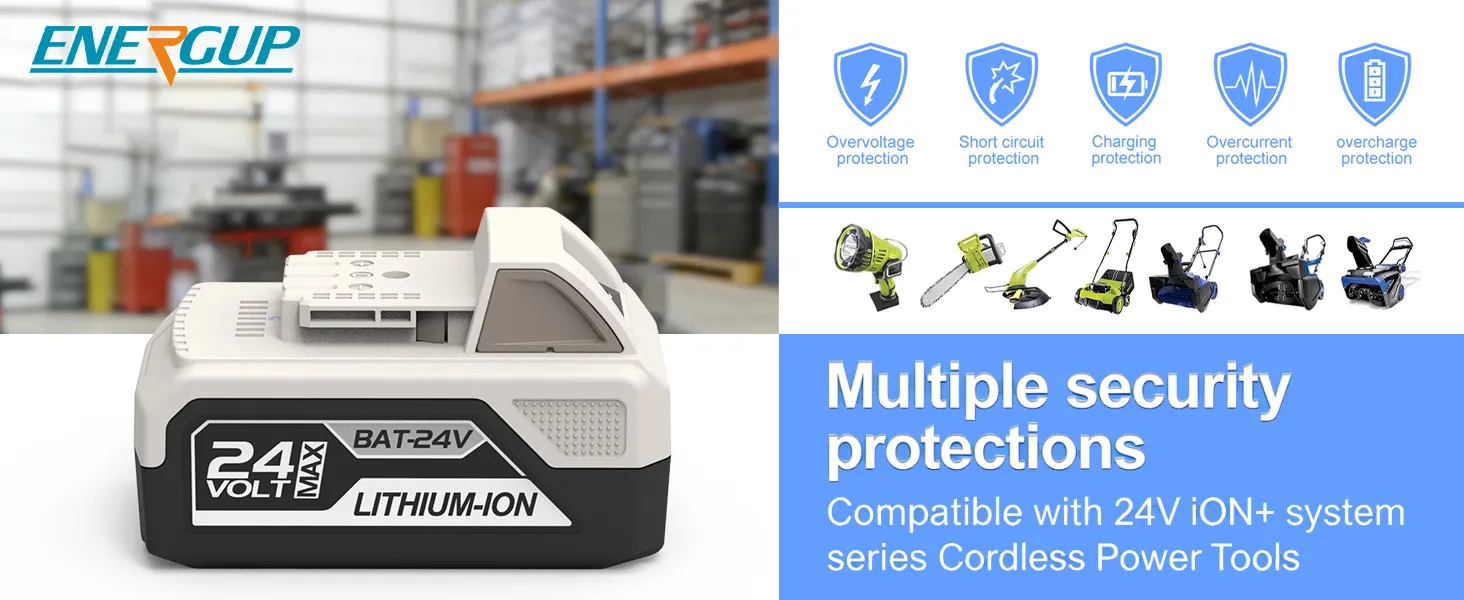
Replacement Snow Joe 24v 24vbat,ltx,lte,lt,xr Power Tool Battery For Snow Joe Power Tools
Charger Performance: Standard vs Fast Charging
Buyers often focus only on compatibility, but charging speed affects workflow. Here is how Snow Joe chargers compare:
| Charger Type | Primary Benefit | Typical Charge Time (4.0Ah) |
|---|---|---|
| Standard Charger | Reduced stress on battery, longer cycle life | ~120 min |
| Fast Charger | Reduced downtime | ~60 min |
| Dual‑Port Charger | Manage two batteries simultaneously | 60 min each (fast) |
| Commercial Charging Station | Fleet‑grade durability, multiple bays | Varies |
Does fast charging damage batteries? When properly engineered, fast chargers operate within safety limits. Our fast chargers use aluminium heat sinks and active fan cooling to keep PCB temperatures below 85°C. However, at 25°C ambient, standard charging (0.5C) delivers 500+ cycles to 80% capacity, while fast charging (1C) yields about 300 cycles—a trade‑off you can manage based on usage intensity.
How Procurement Teams Validate Charger Compatibility
For distributors, rental fleets, and maintenance providers, verifying compatibility before approval is critical. We recommend these tests with clear pass/fail criteria:
| Test | Purpose | Pass Criteria |
|---|---|---|
| Charger Recognition Test | Confirms battery detection | Charger acknowledges battery within 2 sec |
| Charging Performance Test | Verifies normal charge cycle | Termination current drops to < 10% of initial |
| Thermal Evaluation | Assesses charging temperatures | Battery temp rise < 15°C above ambient |
| Charge Retention Test | Evaluates effectiveness | Battery holds ≥ 90% charge after 24 h |
| Multi‑Sample Validation | Confirms consistency | All samples pass the above |
These tests align with industry standards such as UL 1310 and IEC 62133, which govern electrical safety and thermal management.
From PCBA to Finished Packs – Your Complete Outsourcing Partner
Are you a brand owner, distributor, or fleet operator looking for reliable, high‑performance replacement batteries and chargers? XNJTG offers turnkey solutions tailored to your needs:
- OEM/ODM battery packs for power tools, garden tools, and vacuum cleaners (3.6V to 80V).
- Smart chargers with proprietary air‑cooling technology for extended battery life.
- Global warehousing (300,000 sq. ft. in North America & Europe) for fast, cost‑effective delivery.
Whether you need a custom BMS PCBA or a full product line under your brand, our engineering team is ready to bring your vision to life.
Frequently Asked Questions
Can I use a third‑party charger for my Snow Joe battery?
No. Third‑party chargers often lack the proper communication protocol and temperature monitoring. Using them voids your warranty and poses a serious fire risk. Always use Snow Joe‑approved chargers.
Why is my Snow Joe charger blinking red?
Red blinking usually indicates a fault. Check the pattern: rapid blink = temperature issue (battery too hot or cold); slow blink = communication error (battery not recognised or BMS fault). Refer to your manual for exact codes.
How long does a Snow Joe battery take to charge?
It depends on capacity and charger type. For a 4.0Ah battery: standard charger ≈2 hours, fast charger ≈1 hour. For 6.0Ah, add 50% more time.
Can I store my batteries in the garage during winter?
We recommend storing batteries at 40–60°F (4–15°C) in a dry place. Cold storage is fine, but never charge a frozen battery. Allow it to warm to room temperature before charging.
Fleet Operator’s 5‑Step Weekly Charger Health Check
- Visual inspection – Check terminals for corrosion or debris; clean with a dry cloth.
- Smell test – Any sweet or pungent odour indicates electrolyte leakage; remove the battery immediately.
- LED verification – Plug in a known‑good battery and confirm normal charging sequence.
- Standby power – Unplug the charger; measure no‑load power draw (should be < 0.5W).
- Document – Log any anomalies to track charger performance over time.