
Dyson V6–V12 Pack Designs — Cell Form Factor and BMS Differences
Dyson V6–V12 packs vary in cell form factor (18650, 21700, pouch) and BMS design. Each combination impacts runtime, thermal response, charge/boost behavior, and serviceability. Proper field-to-lab test protocols, IR/OCV logging, teardown inspection, and golden-unit acceptance are essential for safe aftermarket evaluation. Procurement must enforce traceability, thermistor/BMS mapping, and standardized RMA/golden-pack checks to minimize field failures.
1. Audience & Purpose
Summary: Intended for service centers, repair technicians, aftermarket suppliers, and fleet/rental buyers. This guide provides a technical framework to interpret pack differences, evaluate replacement packs, and enforce acceptance testing.
Problem solved: Clarifies why understanding cell/BMS differences is critical for runtime, safety, and warranty compliance.
Added depth: Each role gains actionable steps for pack evaluation, from visual teardown to lab propagation tests.
2. Safety First (Must-read)
Summary:
-
Avoid swollen, smoking, or hot packs (>50°C).
-
Only perform destructive tests in certified labs with gas monitoring.
-
Prioritize non-invasive diagnostics: OCV, IR, swap tests.
Added depth:
-
Recommended PPE: insulated gloves, safety goggles, blast shield.
-
Isolation procedures: non-combustible tray, ≥1m spacing between suspect packs.
-
Logging: timestamp, ambient temperature, pack serial, and SOC before any test.
3. Platform Overview (V6 → V12)
Summary: Evolution from V6 → V11/V12 includes voltage, capacity, packaging, internal layout, removable vs integrated modules, terminal arrangement, and BMS placement differences.
Added depth:
-
V6/V7: typically 4–6 cell 18650 packs, lower Ah, minimal BMS features.
-
V8/V10: 21700 transition, increased capacity, added soft-limit BMS logic.
-
V11/V12: high-density packs, multiple thermistor points, tighter thermal pathways, staged protection, optimized for FLEX/boost mode.
Problem solved: Explains load behavior, charge efficiency, and thermal profiles across generations.
4. Cell Form Factors (18650 / 21700 / Pouch)
Summary:
-
18650: Proven mechanical stability, moderate thermal mass, IR ≈ 30–50 mΩ typical at 20°C.
-
21700: Higher energy density, lower per-cell resistance, slightly higher thermal rise under identical load.
-
Pouch: Thin form, swelling risk, less robust mechanical protection, uneven thermal dissipation.
Additional metrics:
-
Series/parallel grouping affects per-cell balancing, propagation risk, and IR rise.
-
ΔV thresholds per cell: 50–80 mV under 10s pulse for acceptance.
-
Thermal headroom: ensure max ΔT < 45°C under typical duty cycle.
Problem solved: Provides quantitative insight for technicians and procurement teams evaluating aftermarket pack performance.
5. BMS Roles & Handshake Differences
Summary:
-
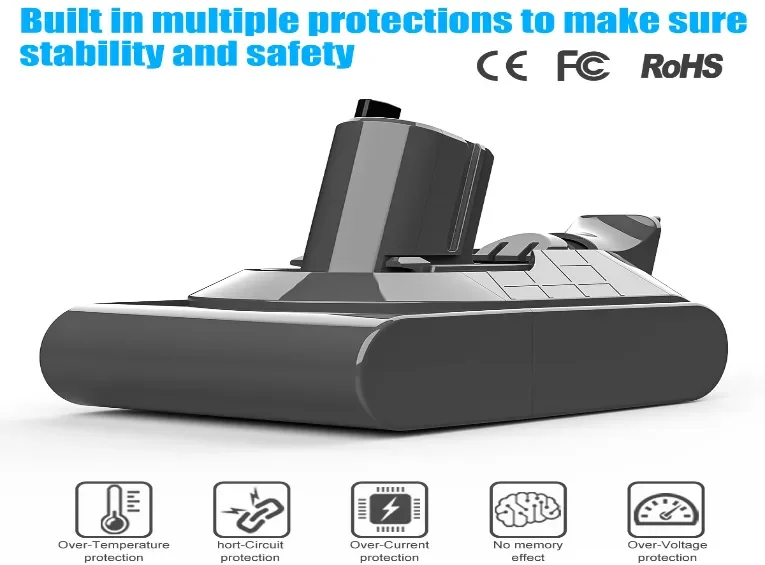
Core protections: overvoltage, undervoltage, overcurrent, short-circuit, thermal, balancing.
-
Thermistor mapping: critical for charge curve adherence; each generation may have 2–3 thermistors at strategic points.
-
Handshake/ID: resistor-based or digital ID; mismatch causes derate or disabled boost mode.
-
Protection staging: soft limits → hard cutoff → latching.
-
Diagnostics: logs, error codes, fault events stored for RMA evidence.
Added depth:
-
Response times: short-circuit <100 µs typical for MOSFET cutoff.
-
Thermal limits: 50–55°C soft limit, 65°C hard cutoff per cell in V11/V12.
-
Charger behavior: ID mismatch reduces charge current by 20–50% or prevents activation entirely.
6. Teardown Highlights (What to Inspect)
Summary:
-
Exterior: terminals, labeling, venting, enclosure integrity.
-
Internal: cell layout, busbar/weld quality, thermistor placement, fuses/PTC, bracing, insulation.
-
Common defects: weak welds, poor thermal barriers, loose boards, misaligned cells.
Added depth:
-
Thermal imaging during teardown to detect hotspots.
-
Micro-cracks on busbars, especially in high-Ah packs.
-
Mechanical stress points: corner cells in pouch or 21700 arrays.
-
Cross-reference with IR pulse test to validate pack homogeneity.
7. Reproducible Test Protocol (Field → Bench → Lab)
Field Tests:
-
Swap tests, OCV per pack/cell, IR spot checks, LED logs.
-
Load under typical duty cycle: measure ΔV and ΔT.
Bench Tests:
-
Controlled cycles with datalogging.
-
Pulse IR at rated current, thermistor mapping, inrush/derate response.
-
Cold/hot environment verification (5–40°C).
Lab Tests:
-
Propagation tests (destructive only in certified facilities).
-
Micro-CT for structural assessment, weld integrity, and electrode alignment.
Acceptance Gates:
-
ΔV per cell ≤70 mV pulse
-
IR rise ≤50 mΩ at 25°C
-
Max cell surface ΔT ≤50°C
-
BMS logs match golden-unit thresholds
Problem solved: Standardizes evaluation across fleets and aftermarket batches.
8. Acceptance & Procurement Checklist
-
Cell vendor traceability
-
Thermistor/BMS handshake disclosure
-
Golden-unit matrix testing
-
IR thermal maps under full duty
-
ICA/EIS baseline
-
UN38.3 and independent safety reports
-
5 serialized sample packs per lot
-
12-month warranty covering thermal and capacity issues
9. Repair vs Replace Decision Rules
-
Replace if swollen, smoking, odor, OCV <17 V, busbar/weld damage.
-
Repair only if lab-certified, modular, and cost <50% of replacement.
-
Track recurring BMS events to predict replacement cycles.
10. Operator & Fleet SOPs
-
Use golden chargers and controlled ambient staging
-
Rotate packs to balance cycle counts
-
Track IR trends and ΔV anomalies
-
Remove packs with repeated BMS warnings or abnormal thermal signatures
11. Visuals & Assets Suggested
-
Internal layout diagrams for V6/V8/V11/V12
-
Cell type, Ah, runtime, failure mode comparison table
-
Field→bench→lab flowchart
-
IR thermal maps, ΔV/ΔT charts
-
Golden-unit acceptance matrix CSV
12. Conclusion
Runtime, safety, and serviceability are governed by both cell form factor and BMS behavior. Enforce standardized acceptance testing, traceability, and procurement checks to mitigate aftermarket risks.