
How Temperature Affects Makita BL Packs in Continuous Operation
This article explains how temperature becomes the primary limiting factor for Makita BL-series 18V batteries during continuous-duty operation, where sustained current prevents cooling and causes heat to accumulate in cells, busbars, and BMS components. Rising temperature alters electrical behavior: DCIR increases beyond the optimal range, voltage sag worsens, weak cell groups hit undervoltage earlier, and BMS thermal protection triggers abrupt shutdowns, forming a heat–DCIR–sag positive feedback loop that also accelerates long-term degradation. The guide outlines safe, reproducible field and bench diagnostics—OCV checks, controlled continuous tasks, IR thermal mapping, and pulse DCIR tests—to distinguish pack limits from tool issues. It details why high-load tools and hot environments are worst case, how repeated overheating shortens service life, and provides practical mitigation strategies, including using higher-Ah packs, enforcing rest/rotation policies, improving contacts and cooling, and validating designs with thermal mapping and long-duration tests rather than relying on intermittent-use assumptions.
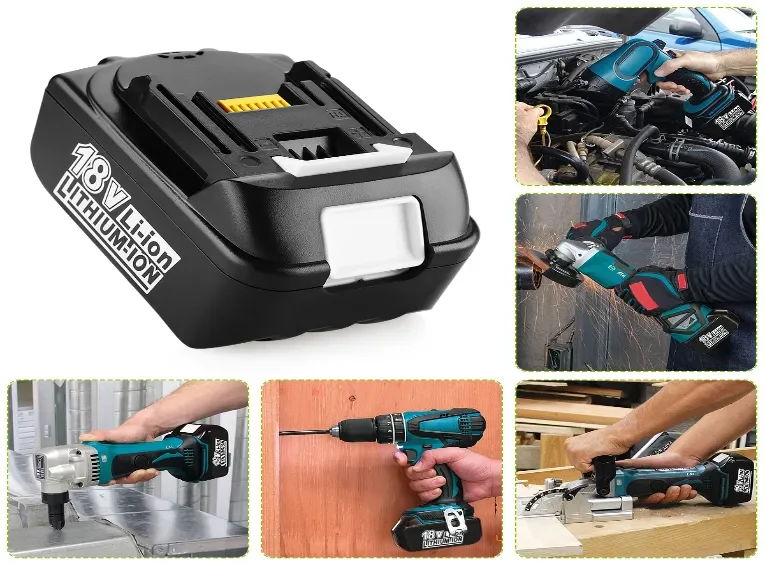
In continuous-duty operation, temperature—not nominal capacity—becomes the primary limiting factor for Makita BL-series 18V packs, as sustained heat buildup increases DCIR, amplifies voltage sag, and ultimately triggers Makita BMS thermal or undervoltage shutdowns while accelerating long-term degradation. Makita BL packs are optimized for intermittent high-power use, so cutting, grinding, sanding, and mowing remove the thermal recovery periods that normally protect the cells.
Safety first
- If a pack is very hot (> ~50 °C), smells burned, swells, or vents — stop, move it outdoors to a non-combustible surface and QUARANTINE. Do not charge or attempt repairs.
- Use current-limited supplies and RCD/GFCI for bench power-ups. Do not attempt cell-level teardown outside a certified lab with blast containment and PPE.
- Maintain ESD controls and keep hands/tools insulated during handling.
How heat is generated in continuous operation
- Cell I²R losses: sustained high currents cause continuous joule heating inside each cell.
- BMS and MOSFET losses: conduction and switching losses add to pack heating during long duty.
- Contact & busbar resistance: poor contacts or thin bus traces concentrate heat locally.
Continuous duty eliminates the recovery periods available in intermittent use, so heat accumulates until thermal limits are reached.
Electrical effects of rising temperature
1. DCIR behaviour: DCIR may slightly decrease at low warming, but beyond the optimal window DCIR rises quickly, increasing voltage sag under load.
2. Voltage sag & group imbalance: higher DCIR increases per-pulse and sustained sag; a weak series group can hit undervoltage sooner than pack average.
3. Thermal-triggered BMS cut: thermistors monitored by the BMS detect over-temp and open MOSFETs; shutdown is protective and often abrupt.
4. Positive feedback loop: heat → higher DCIR → more heat → earlier cutoff and long-term degradation.
Application & ambient dependency
- Worst-case: tools that combine high continuous current and long duty (grinders, saws, sanders).
- Ambient extremes: high ambient temperature or direct sun reduces thermal headroom; cold raises initial DCIR and can accelerate heating under load.
- Two packs can behave differently on the same tool due to age, cell batch, DCIR, or minor BMS calibration differences.
Reproducible diagnostic checks
Field:
1. Charge pack fully, rest 30–60 min, record OCV.
2. Run a consistent continuous task and time to first thermal discomfort or cutoff; measure surface temp with IR.
3. Swap packs (same tool) to see whether the pack or tool is the limiting factor.
Bench:
1. Constant-current discharge mimicking tool drain while logging V(t) and I(t).
2. IR thermal mapping during run to identify hotspot locations (cells vs busbars vs BMS).
3. Pulse DCIR tests at representative SOCs to quantify sag and compare to golden units.
Stop tests immediately on smell, smoke, swelling or rapid temp jumps.
Long-term consequences of repeated overheating
- Permanent DCIR increase and capacity fade.
- Worsening cell imbalance and more frequent BMS cutouts.
- Reduced usable runtime and earlier end-of-life.
Thermal damage compounds over cycles — each thermal event shortens the next run’s thermal margin.
Mitigation strategies
Operator / fleet practices:
- Use higher-Ah packs for continuous-duty tools to reduce per-cell C-rate.
- Schedule rest intervals; rotate packs to allow cooling.
- Keep terminals clean and ensure firm seating.
- Store spares cool and at moderate SOC (~30–50%).
Engineering / manufacturing:
- Select low-DCIR cells and match cell batches; design heavy-copper or multi-plane current paths.
- Place thermistors near expected hotspots and calibrate BMS thresholds to real duty cycles.
- Improve thermal paths (vias, heat spreaders) and design for airflow if pack housings permit.
- Validate with IR thermal mapping and long-duration duty testing during qualification.
Troubleshooting flow
1. Safety check (heat/odor/swelling)? → If yes: QUARANTINE.
2. Swap test: suspect pack in golden tool, golden pack in suspect tool.
3. Run one repeatable continuous task while logging V/I and taking IR snapshot at cutoff.
4. If thermal-driven: increase pack Ah, add rest cycles or retire pack if DCIR high.
5. If only one tool causes early trips: inspect tool motor/controller and terminal contacts.
Summary — one-line takeaway + 3 immediate actions
Temperature is the key limiter in continuous operation: rising temperature raises DCIR, which increases voltage sag and triggers BMS cutouts; repeated overheating accelerates permanent degradation.
Immediate actions:
1. Instrument one representative tool+pack run (V(t), I(t), IR image) to get baseline.
2. For continuous-duty tools, test and pilot using higher-Ah packs and measure time-to-cutoff.
3. Add mandatory rest/rotation policy for packs used in continuous operations.
Frequently Asked Questions
Q — Why does a pack shut down only after several minutes, not immediately? A — Continuous operation allows heat to build up; initial performance may be fine but DCIR and cell temperature rise over minutes until a BMS thermal or undervoltage threshold is reached.
Q — Will using a bigger (Ah) pack always fix thermal shutdowns?
A — Larger packs reduce per-cell C-rate and usually help, but if the pack has high DCIR (age or damage) or poor thermal design, the problem can persist.
Q — Are shutdowns more likely in summer?
A — Yes. High ambient temperature reduces cooling capacity and shortens thermal headroom, so cutoffs occur earlier.
Q — Can cooling packs (fan or airflow) safely extend runtime?
A — Improved airflow around the pack housing helps reduce surface temperature and can delay cutoff, but forced cooling must not introduce water/contaminants and should respect pack thermal expansion/venting design.
Q — Should BMS thresholds be adjusted to tolerate more heat?
A — No. Raising protection thresholds risks cell damage and safety. Instead, address root causes: lower per-cell stress, improve cooling, or use higher-spec packs.