
Kobalt 24V Battery Not Charging: Troubleshooting Guide 2026
This B2B guide explains why Kobalt 24V batteries fail to charge and provides a step‑by‑step troubleshooting process. It covers temperature protection, deep discharge, dirty contacts, charger communication issues, LED indicator meanings, battery aging signs, and when to replace vs repair. Includes a 7‑step diagnostic workflow, safety warnings, and supplier validation requirements. Essential for distributors, repair centers, and fleet operators.

Most Kobalt 24V charging failures are caused by temperature conditions, deep discharge, charger issues, poor electrical connections, or normal battery aging—not necessarily a defective battery. Before replacing any component, follow a structured troubleshooting process and verify both charger and battery performance. When replacement becomes necessary, prioritize products supported by compatibility validation, safety testing, runtime verification, and traceable manufacturing documentation rather than price alone.
📌 Key Takeaways
- Not all charging failures mean battery replacement. Temperature protection, dirty contacts, and charger issues are often the cause.
- Temperature protection is the most misunderstood cause. Batteries stored below 0°C (32°F) may refuse charging until warmed.
- LED indicators provide valuable diagnostic clues. Steady vs flashing lights reveal different fault conditions.
- Cross-testing is the fastest diagnostic method. Test the battery on another charger and another battery on the same charger.
- Deep discharge can trigger BMS lockout. Long-term storage without maintenance charging may permanently deactivate the battery.
- 1. What Does "Kobalt 24V Battery Not Charging" Actually Mean?
- 2. How Does the Kobalt 24V Charging System Work?
- 3. What Should You Check Before Assuming the Battery Is Dead?
- 4. Why Are Temperature-Related Charging Stops So Common?
- 5. Can Dirty Contacts Prevent Charging?
- 6. Can Deep Discharge Trigger Battery Protection Shutdown?
- 7. What Can Charger LED Indicators Tell You?
- 8. How Do You Know When a Kobalt 24V Battery Is Reaching End of Life?
- 9. Recommended Step-by-Step Troubleshooting Workflow
- 10. What Safety Warning Signs Should Never Be Ignored?
- 11. When Should You Replace the Battery Instead of the Charger?
- 12. What Should a Reliable Replacement Battery Supplier Prove?
- 13. Common Buying Mistakes After a Charging Failure
- 14. FAQ
- 15. Conclusion
🔋 What Does "Kobalt 24V Battery Not Charging" Actually Mean?
The phrase "not charging" can describe several different failure scenarios. Understanding the exact symptom is the first step toward finding the real cause.
| Symptom | Possible Cause |
|---|---|
| Charger does not recognize battery | Charger compatibility issue, contact problem, BMS lockout |
| Charging starts then stops | Temperature protection or charger fault |
| Flashing LED indicator | Charging error or battery fault |
| No indicator response | Deep discharge or charger failure |
| Battery charges but runtime is very short | Battery aging or cell degradation |
⚙️ How Does the Kobalt 24V Charging System Work?
Before troubleshooting, it helps to understand how the charging process operates.
Four components must work together:
| Component | Function |
|---|---|
| Battery Pack | Stores energy and communicates with the charger |
| Battery Management System (BMS) | Monitors voltage, current, and temperature |
| Charger | Controls charging current and safety logic |
| Tool Electronics | Regulates power delivery during operation |
If any one of these components fails to communicate properly, charging may stop or never begin.
Why voltage alone does not determine charging success: Many users assume that if a battery measures voltage, it should charge normally. However, modern lithium-ion systems also verify temperature conditions, cell voltage balance, charger communication, and safety protection status. A battery may contain usable voltage and still refuse to charge due to a protection lockout.
✅ What Should You Check Before Assuming the Battery Is Dead?
Many charging problems can be identified within minutes.
Verify charger power: Confirm that the power outlet functions properly, charger indicator lights operate normally, and power cords show no damage.
Confirm the battery is fully seated: Even a slight misalignment can prevent proper charger recognition.
Clean battery and charger contacts: Inspect terminals for dirt, corrosion, oxidation, or debris buildup. Poor electrical contact can interrupt charging communication.
Check battery temperature: Lithium-ion batteries may temporarily reject charging when they are too cold or too hot.
Cross-test with known-good equipment: The fastest diagnostic method is often to test the battery on another charger and test another battery on the same charger. This quickly isolates the faulty component.
🌡️ Why Are Temperature-Related Charging Stops So Common?
Temperature protection is one of the most misunderstood causes of charging failure.
Why does it happen? The Battery Management System continuously monitors battery temperature. If the battery is outside the approved charging range, the system may temporarily suspend charging. This is a normal safety feature.
Common symptoms: Users often observe flashing charger indicators, charging delays, charger refusing battery recognition, or charging resuming after warming.
Why winter causes more charging complaints: Kobalt 24V batteries are frequently used for outdoor work. A battery brought directly from a freezing garage may appear defective even though the battery itself is healthy. Once returned to room temperature, normal charging often resumes.
Prevention tips: Avoid long-term storage in freezing environments, allow batteries to warm before charging, avoid charging immediately after heavy use, and store batteries indoors during winter.
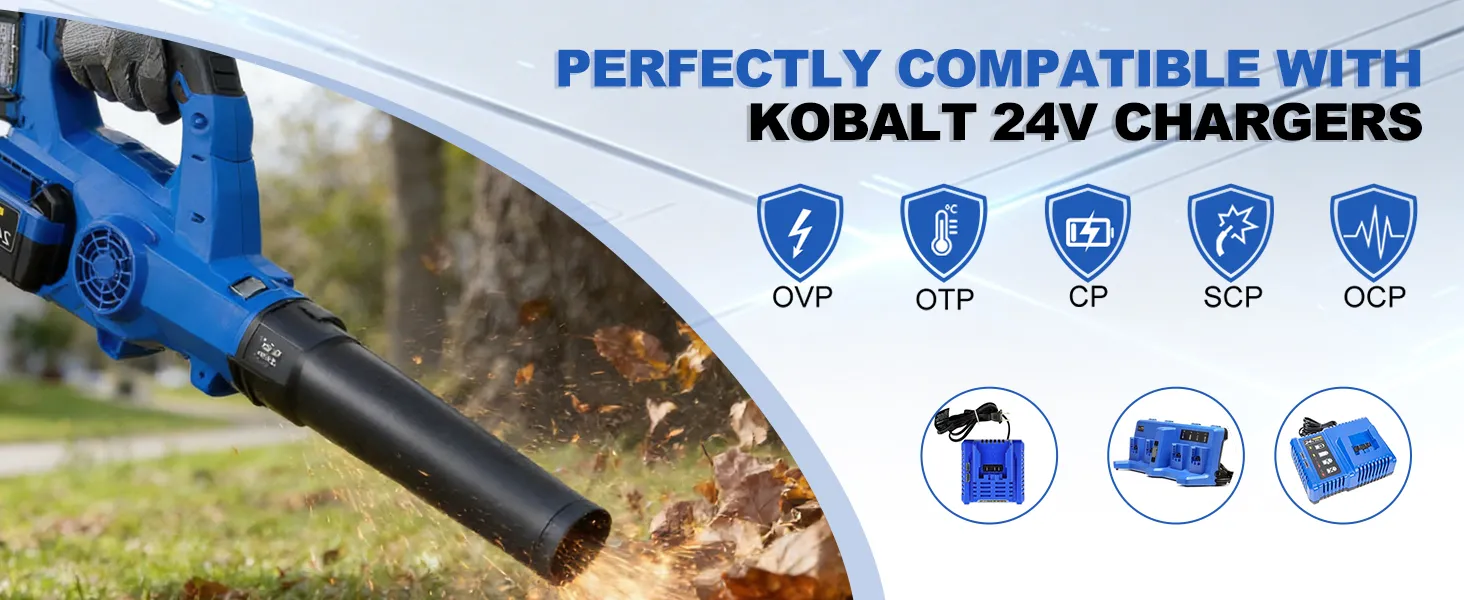
Replacement 24v Battery For Kobalt Tools
🧹 Can Dirty Contacts Prevent a Kobalt Battery from Charging?
Yes. A surprisingly high number of charging complaints originate from poor electrical connections.
Common symptoms: Intermittent charging, battery not recognized, or charging starts and stops unexpectedly.
Why contacts matter: Modern chargers exchange information with the battery through terminal connections. Contamination may interrupt power transfer, temperature sensing, and battery identification signals.
Recommended solution: Inspect terminals carefully, remove debris, clean contacts gently, and verify secure battery seating. Regular inspection can prevent many charging problems.
🔋 Can Deep Discharge Trigger Battery Protection Shutdown?
Yes. Deep discharge is one of the most common causes of batteries appearing completely dead.
Why does deep discharge occur? Lithium-ion batteries naturally lose a small amount of charge during storage. If stored for long periods without maintenance charging, voltage may eventually fall below the BMS protection threshold. The battery may then enter a protective shutdown state.
| Symptom | Likely Cause |
|---|---|
| No charger response | Deep discharge |
| No LED activity | Protection shutdown |
| Battery appears dead | Voltage below recognition threshold |
Can the battery be recovered? Sometimes. Recovery depends on battery age, storage duration, cell condition, and depth of discharge.
When is replacement more practical? Replacement is usually recommended when the battery has been deeply discharged for months, runtime was already declining before storage, or recovery attempts fail repeatedly.
💡 What Can Charger LED Indicators Tell You?
LED indicators provide valuable diagnostic information. For Kobalt 24V chargers:
- Steady green — typically indicates charging in progress
- Flashing red — common causes include temperature protection, battery fault, charger communication failure, or internal battery protection lockout
- Flashing green — depending on charger design, may indicate active charging, charge completion, or a temporary charging pause
- No LED response — check the power outlet and charger connection
Every XNJTG replacement battery/charger is tested for correct fit, charger handshake, and thermal cut-off before leaving our facility. We help you avoid the “physical fit but system fail” trap.
Get free technical consultation, sample test reports, and bulk pricing → Contact our engineering team
⏳ How Do You Know When a Kobalt 24V Battery Is Reaching End of Life?
Lithium-ion batteries gradually lose capacity over time.
Common end-of-life indicators: Significant runtime reduction, longer charging times, frequent overheating, rapid self-discharge, and failure to reach full charge.
| Aging Factor | Effect |
|---|---|
| High temperatures | Accelerates cell degradation |
| Heavy cycle usage | Reduces capacity over time |
| Deep discharge events | Increases cell stress |
| Long-term storage | May reduce usable capacity |
Typical signs users notice first: Most users first notice shorter runtime, more frequent charging, and reduced tool performance under heavy load.
🧪 Recommended Step-by-Step Troubleshooting Workflow
Before purchasing a replacement battery, follow this process:
- Verify charger power — Confirm the charger is functioning correctly.
- Inspect battery terminals — Check for contamination or corrosion.
- Normalize battery temperature — Allow the battery to reach room temperature.
- Test with a known-good charger — Determine whether the charger is causing the issue.
- Test with a known-good battery — Determine whether the battery is causing the issue.
- Observe LED indicator behavior — Document any flashing or error patterns.
- Review runtime history — Consider whether performance was declining before the charging failure.
- Inspect for physical damage — Look for cracks, swelling, or heat damage.
⚠️ What Safety Warning Signs Should Never Be Ignored?
Immediately discontinue use if you observe:
- Battery swelling
- Cracked housing
- Burning odor
- Excessive heat generation
- Melted terminals
- Smoke
🔧 When Should You Replace the Battery Instead of the Charger?
The answer depends on testing results.
Battery replacement is usually appropriate when:
- Runtime has declined significantly
- Multiple chargers fail to recognize the battery
- Physical damage exists
- The battery no longer accepts a full charge
Charger replacement is more likely when:
- Multiple batteries fail on the same charger
- Charger indicators behave abnormally
- Charger output cannot be verified
Cross-testing remains the most reliable diagnostic method.
📋 What Should a Reliable Replacement Battery Supplier Prove?
A professional supplier should provide objective evidence rather than marketing claims.
| Validation Area | Why It Matters |
|---|---|
| Kobalt 24V Platform Compatibility | Ensures proper fit and operation |
| Charger Compatibility Testing | Verifies charging behavior |
| Capacity Verification | Confirms usable energy |
| Runtime Testing | Demonstrates real-world performance |
| Thermal Testing | Validates safety systems |
| Internal Resistance Consistency | Indicates cell quality |
| Batch Traceability | Supports manufacturing quality control |
Why documentation matters: Professional suppliers should provide compatibility reports, runtime verification records, structured test logs, and production traceability information. Documented testing provides more confidence than advertised specifications alone.
⚠️ Common Buying Mistakes After a Charging Failure
- Mistake #1: Replacing the battery before testing the charger — the charger may actually be responsible.
- Mistake #2: Assuming all 24V batteries are interchangeable — platform compatibility still matters.
- Mistake #3: Buying solely based on price — low-cost batteries may sacrifice consistency and testing.
- Mistake #4: Ignoring charger compatibility — battery and charger should always be evaluated as a complete system.
- Mistake #5: Evaluating only one sample — single-unit testing does not always represent overall product quality.
❓ FAQ
Why is my Kobalt 24V battery not charging?
The most common causes are temperature protection, deep discharge, dirty contacts, charger issues, and battery aging.
Can a deeply discharged Kobalt battery be recovered?
Sometimes, depending on storage history, battery age, and overall cell condition.
What does a flashing red light on a Kobalt charger mean?
It often indicates temperature protection, communication problems, or a battery fault.
Should I replace the charger or battery first?
Cross-testing with known-good equipment is the best diagnostic approach.
Are aftermarket Kobalt batteries safe?
Yes, provided they include proper protection systems, verified compatibility, quality cells, and documented testing.
🎯 Conclusion
Conclusion: Most Kobalt 24V charging failures are caused by temperature conditions, deep discharge, charger issues, poor electrical connections, or normal battery aging—not necessarily by a defective battery. Before replacing any component, follow a structured troubleshooting process and verify both charger and battery performance. When replacement becomes necessary, prioritize products supported by compatibility validation, safety testing, runtime verification, and traceable manufacturing documentation rather than price alone.